
About QOS MSP
QOS MSP is the outsourced IT department for Indianapolis-area businesses - managed IT, cybersecurity, cloud, and IT leadership from one accountable team. Part of QOS, delivering IT since 2007.
Contact Info
- PO Box 14, Sheridan, IN 46069
- +1 (877) 800-7672
- info@qosmsp.com
- Monday-Friday, 8:00 AM - 5:00 PM
Fractional CIO Services in Indianapolis
Core Fractional CIO Services We Provide
Executive IT leadership for growing Indiana businesses that need direction, not just support.
IT Strategy & Planning
We align your technology decisions with business goals through a documented, multi-year IT strategy.
Technology Roadmap
A prioritized, budgeted plan showing which technology changes happen when — and why each one matters.
IT Budgeting & Forecasting
Predictable annual IT budgets and forecasts so hardware, software, and projects never blindside your finances.
Vendor Management
We manage your software, hardware, and telecom vendors — negotiating contracts and holding them accountable.
Risk & Compliance Oversight
Executive oversight of cybersecurity risk, data protection, and compliance obligations before they become incidents.
IT Governance & QBRs
Structured quarterly business reviews where IT decisions get made, tracked, and put on record.
Fractional CIO vs. Hiring a Full-Time CIO
Most growing businesses need CIO-level direction long before they can justify a full-time executive salary. Here's how the two options compare.
Hiring a Full-Time CIO
- $200K–$280K in loaded annual salary
- Months to recruit and onboard
- One person's knowledge and biases
- Fixed executive overhead, full-time or not
A Fractional CIO from QOS
- A fraction of the cost, scoped to need
- Executive IT leadership in weeks
- A whole firm's experience since 2007
- Scale the engagement up or down
Growing Businesses Hit an IT Leadership Ceiling
Most businesses reach a point where technology decisions outgrow the person making them. The office manager who set up email can’t plan a three-year roadmap. The MSP that fixes tickets isn’t setting your IT budget. Growth stalls when no one owns the strategy.
That’s the gap a fractional CIO fills. You get an experienced technology executive directing your IT the way a full-time CIO would — strategy, budget, roadmap, vendor management, and risk — without carrying a six-figure executive on payroll.
A fractional CIO sits above your day-to-day operations, setting direction for the teams that run your network administration, system administration, and security administration — whether those are in-house staff or an outside provider.
It’s part of a broader fractional IT leadership model that gives growing companies executive-level direction on demand.
What Is a Fractional CIO?
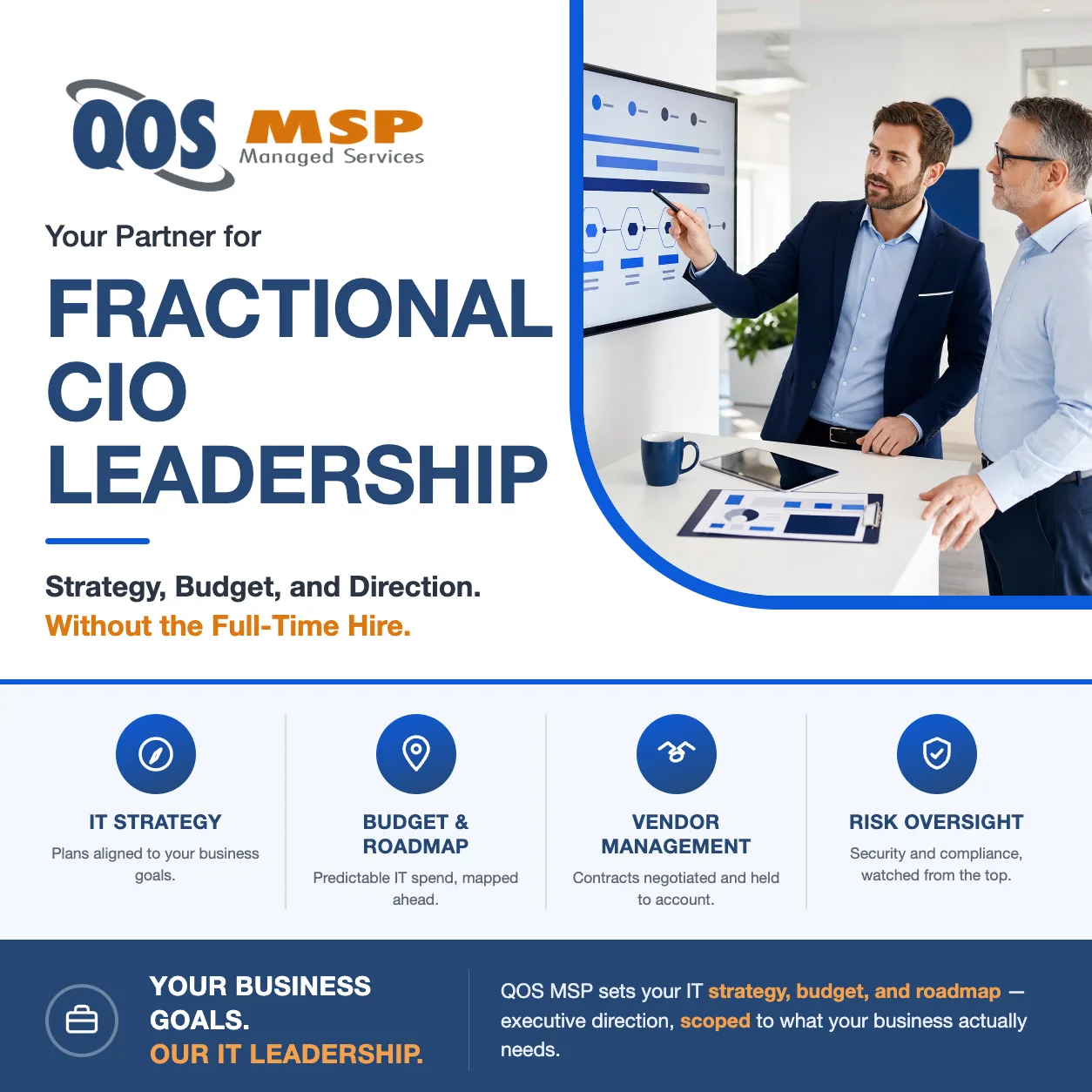
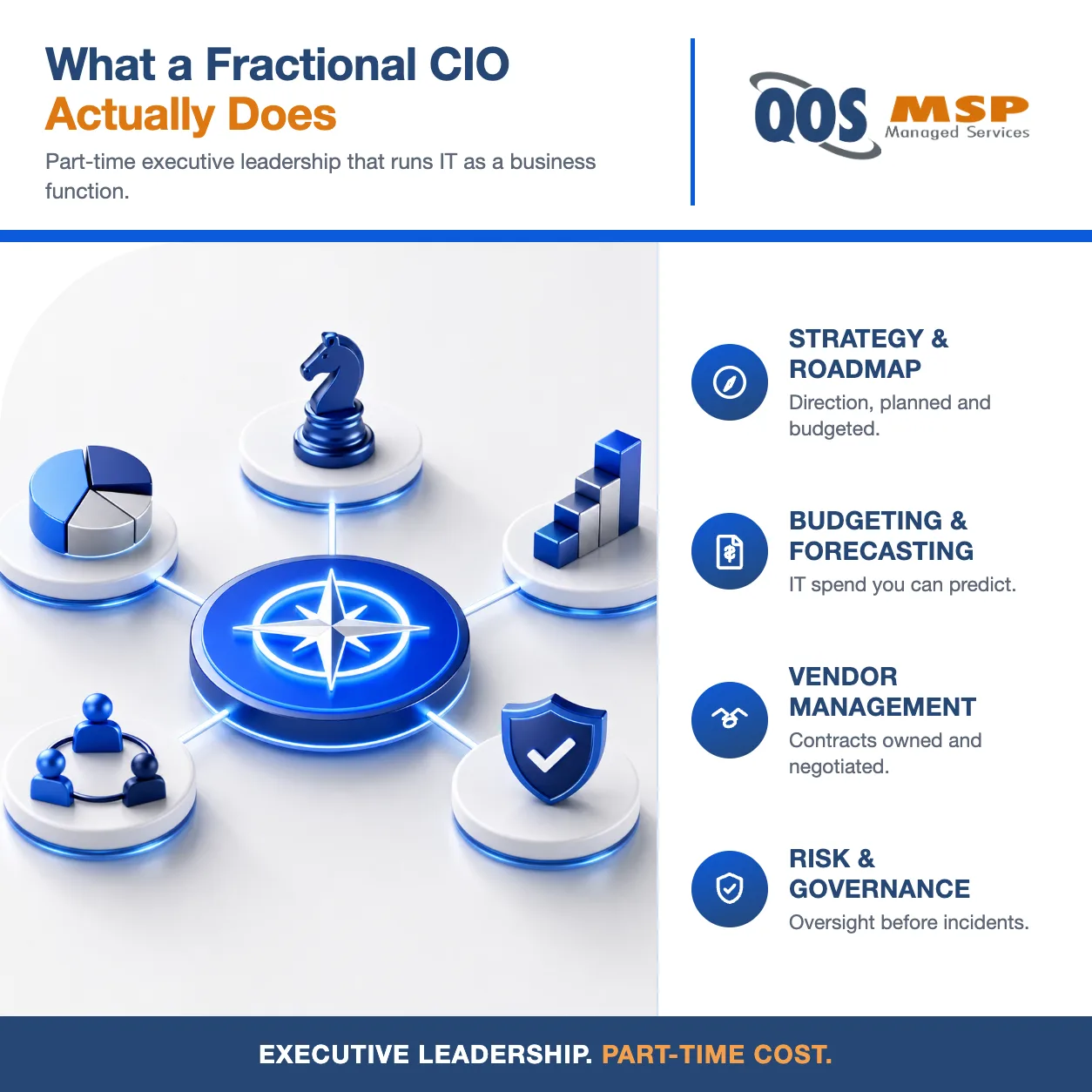
A fractional CIO — also called a virtual CIO or vCIO — is a part-time technology executive who runs IT as a business function: strategy, budgeting, roadmap, vendor management, and risk oversight.
- Multi-year IT strategy aligned to business goals
- Annual IT budgeting and forecasting
- Technology roadmap and prioritization
- Vendor, contract, and license management
- Cybersecurity risk and compliance oversight
- IT governance, policy, and standards
- Quarterly business reviews and reporting
- Technology evaluation and build-vs-buy decisions
Why Indianapolis Businesses Choose QOS for Fractional CIO Leadership
Plenty of providers hand you a "vCIO" who is really an account manager with a sales quota. Since 2007, QOS has led IT as a business function — direction built around your outcomes, not around selling you more of our own services.
- Roadmaps with named dollar figures, not vague phases
- QBRs where decisions get made and put on record
- Vendor recommendations that aren't all QOS
- Independent, conflict-free technology direction

Benefits of a Fractional CIO Engagement
A fractional CIO turns IT from a reactive cost center into a planned, accountable part of the business.

- Executive IT leadership at a fraction of the cost
- Predictable, planned annual IT budgets
- A documented, prioritized technology roadmap
- Stronger vendor contracts and accountability
- Reduced cybersecurity and compliance risk
- Faster, better-informed technology decisions
| Option | Typical cost | What it includes |
|---|---|---|
| Full-time in-house CIO | $200,000–$280,000/yr (loaded) | One executive, full-time overhead, a single perspective |
| Standalone fractional CIO retainer | $3,000–$10,000/mo (market) | Part-time leadership from an independent consultant |
| QOS MSP fractional CIO | Scoped per engagement (quoted) | Leadership backed by a full IT team since 2007 |
A defined leadership scope, quoted per business — not bundled into managed-service device tiers; hardware and vendor subscriptions billed separately.
Weighing the numbers? Our post on in-house IT vs. managed IT cost breaks down the full comparison, or book a free IT strategy consultation and we’ll scope it to your business.
When a Fractional CIO Makes Sense
A fractional CIO fits businesses that need executive technology direction but don't yet need — or can't yet justify — a full-time hire.
- Scaling from 20 to 200 employees
- Operating without a senior IT leader in-house
- Preparing for an audit or funding round
- Overseeing an internal team or an existing MSP


Download the Fractional IT Leadership Buyer's Guide
Not sure whether you need a fractional CIO, a CTO, or a full managed IT team? This guide breaks down each leadership role, what it costs, and how to decide — so you can bring the right level of technology direction into your business without overbuying.
Frequently Asked Questions About Fractional CIO Services
-
What is the difference between a fractional CIO, a virtual CIO, and a vCIO?
They are the same role under different names. "Fractional CIO," "virtual CIO," and "vCIO" all describe a part-time Chief Information Officer who provides executive IT leadership — strategy, budgeting, roadmap, vendor management, and risk oversight — without being a full-time employee. QOS uses "fractional CIO" most often, but the service is identical.
-
How much does a fractional CIO cost?
Standalone fractional CIOs on the open market typically charge $3,000 to $10,000 per month, depending on company size and scope. A full-time in-house CIO runs $200,000 to $280,000 a year once benefits and overhead are included. QOS MSP scopes fractional CIO leadership per engagement and quotes it to your business, with hardware and vendor subscriptions billed separately.
-
Do I need a fractional CIO or a fractional CTO?
Choose a fractional CIO if your priority is internal IT — strategy, budgeting, vendor management, security, and governance for the technology your business runs on. Choose a fractional CTO if your priority is software, product, and development direction. Many companies use both; QOS offers fractional CTO services alongside fractional CIO leadership.
-
What does a fractional CIO do each month?
A fractional CIO works on a regular cadence: setting and revising your IT budget and roadmap, managing vendor contracts and renewals, overseeing cybersecurity and compliance risk, and leading a quarterly business review (QBR) where technology decisions are made and recorded. Between reviews, they provide executive guidance on major technology decisions as they arise.
-
At what size does a business need a CIO?
Most businesses start needing CIO-level direction between roughly 15 and 20 employees, or when IT spending and complexity grow faster than any one person can manage. Below about 15 users you likely don't need one — a strong managed IT provider is usually enough. A fractional CIO bridges the gap until a full-time hire is justified, typically past 200 employees.
-
Can a fractional CIO work alongside our internal IT team or current provider?
Yes. A fractional CIO is designed to sit above day-to-day operations, providing strategy and oversight while your internal staff or existing MSP handle the hands-on work. QOS regularly leads technology direction for businesses that keep their current team or provider in place, adding executive-level planning without replacing what already works.