
About QOS MSP
QOS MSP is the outsourced IT department for Indianapolis-area businesses - managed IT, cybersecurity, cloud, and IT leadership from one accountable team. Part of QOS, delivering IT since 2007.
Contact Info
- PO Box 14, Sheridan, IN 46069
- +1 (877) 800-7672
- info@qosmsp.com
- Monday-Friday, 8:00 AM - 5:00 PM
GDPR Compliance Services
Core GDPR Compliance Services We Provide
Six core services for businesses that need to meet GDPR without building a privacy department.
GDPR Readiness Assessment
We measure your current data practices against GDPR requirements and deliver a prioritized gap report with a remediation plan.
Data Mapping & Classification
We document what personal data you hold, where it lives, how it flows, and who can access it.
Privacy Policies & Documentation
We write the privacy notices, policies, and processing records GDPR expects you to produce on demand.
Consent & Preference Management
We implement processes that collect, record, and prove lawful consent across your website, marketing, and applications.
Data Subject Request Handling
We build DSAR workflows for access, correction, deletion, and portability requests so statutory deadlines never slip.
Breach Response Planning
We prepare incident response and 72-hour notification procedures before you ever need them.
What a Real GDPR Program Changes
If personal data from EU residents flows through your business — customers, subscribers, even website analytics — GDPR already applies to you. The difference is whether you're managing it or hoping.
Without a GDPR program
- Personal data scattered across unknown systems
- Consent collected but never provable
- DSAR deadlines missed or mishandled
- Breach notifications improvised under pressure
With QOS managing GDPR
- Every data store mapped and classified
- Lawful consent recorded and documented
- Rights requests answered on schedule
- 72-hour response plan ready and rehearsed
GDPR Applies to More US Businesses Than Most Expect
The General Data Protection Regulation is an EU law, but its reach doesn’t stop at Europe’s borders. If your business offers goods or services to people in the European Union — or monitors their behavior through website analytics, advertising pixels, or tracking cookies — GDPR applies to you, whether you’re headquartered in Indianapolis or Dublin.
The stakes are real. Regulators can fine non-compliant organizations up to €20 million or 4% of global annual revenue, whichever is higher. In practice, the more common cost for US businesses is commercial: EU customers and partners increasingly require documented GDPR compliance before they’ll sign a contract.
Most small and mid-sized businesses don’t need a European law firm — they need practical controls: knowing what personal data they hold, protecting it properly, and being able to prove both. That’s operational work, and it’s what we do.
QOS MSP folds GDPR into the same managed compliance program that covers HIPAA, SOC 2, and PCI DSS — one partner running your IT, your security, and your privacy obligations together.

What Is GDPR Compliance?
GDPR compliance means meeting the General Data Protection Regulation's requirements for how an organization collects, processes, stores, and protects the personal data of people in the European Union. For most businesses it reduces to two capabilities: knowing your data, and proving you handle it lawfully.
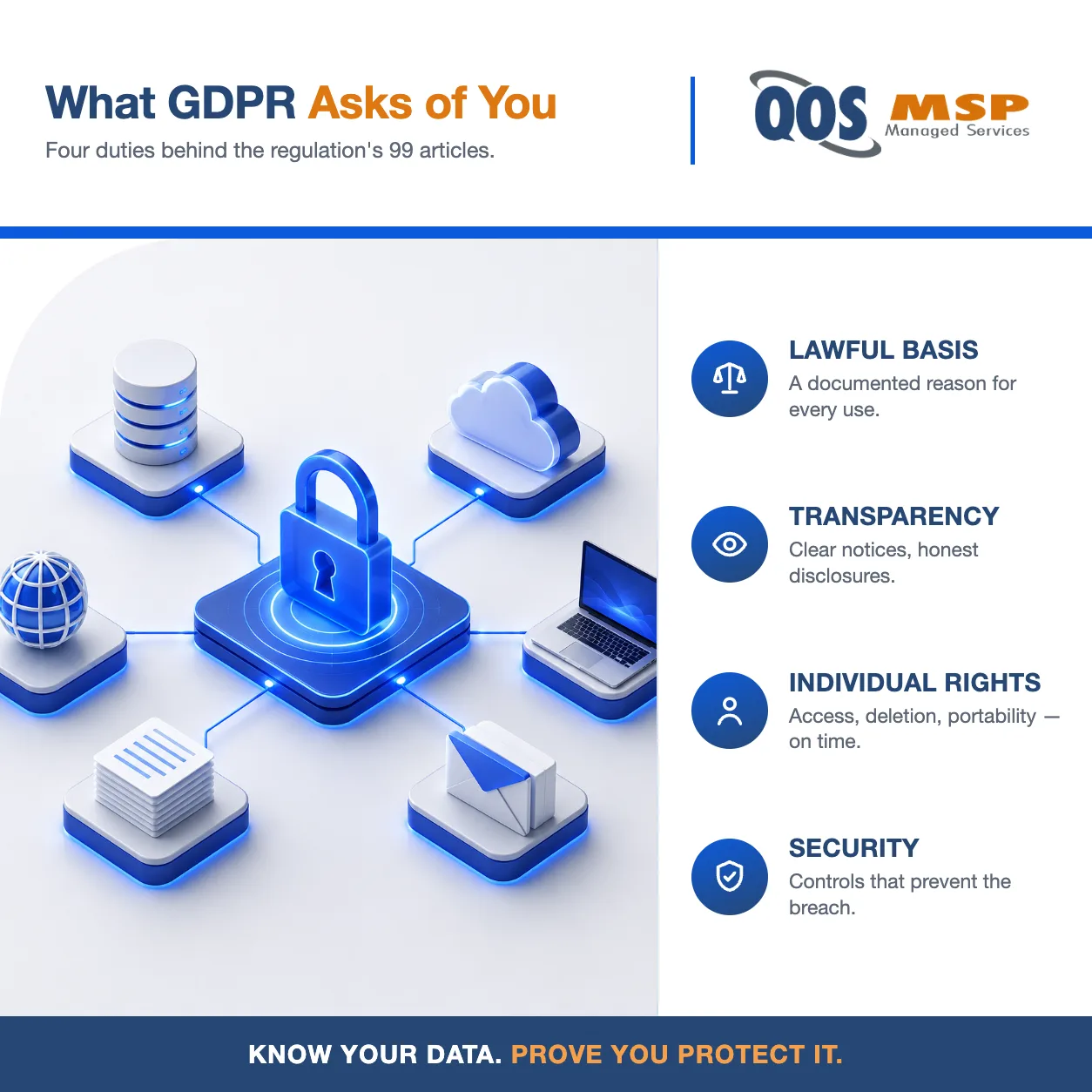
- Lawful basis for all data processing
- Transparent privacy notices and disclosures
- Individual rights handling (access, deletion, portability)
- Valid, documented consent practices
- Privacy by design and by default
- Security of processing (Article 32 controls)
- 72-hour breach notification readiness
- Records of processing activities (RoPA)
Why Indianapolis Businesses Choose QOS for GDPR
GDPR is a European regulation, but the work happens in your systems — and that's local. We run privacy and compliance programs for regulated businesses across Indiana and Illinois every week.
- Flat monthly Compliance-plan pricing
- One partner for IT, security, and privacy
- Controls implemented, not just recommended
- Real experience across HIPAA, SOC 2, and PCI DSS

Benefits of a Managed GDPR Compliance Program
A working GDPR program pays for itself in more places than the fine you never receive.

- Lower regulatory and legal exposure
- Provable accountability for auditors and partners
- Confident expansion into EU markets
- Stronger customer trust and retention
- Tighter security across every system
- Privacy questions answered in hours, not weeks
Who Needs GDPR Compliance Services
GDPR obligations show up in more business models than most owners expect — these are the ones we see most.
- SaaS platforms with EU users
- eCommerce stores selling into Europe
- Marketing teams holding EU subscriber lists
- B2B firms serving European clients

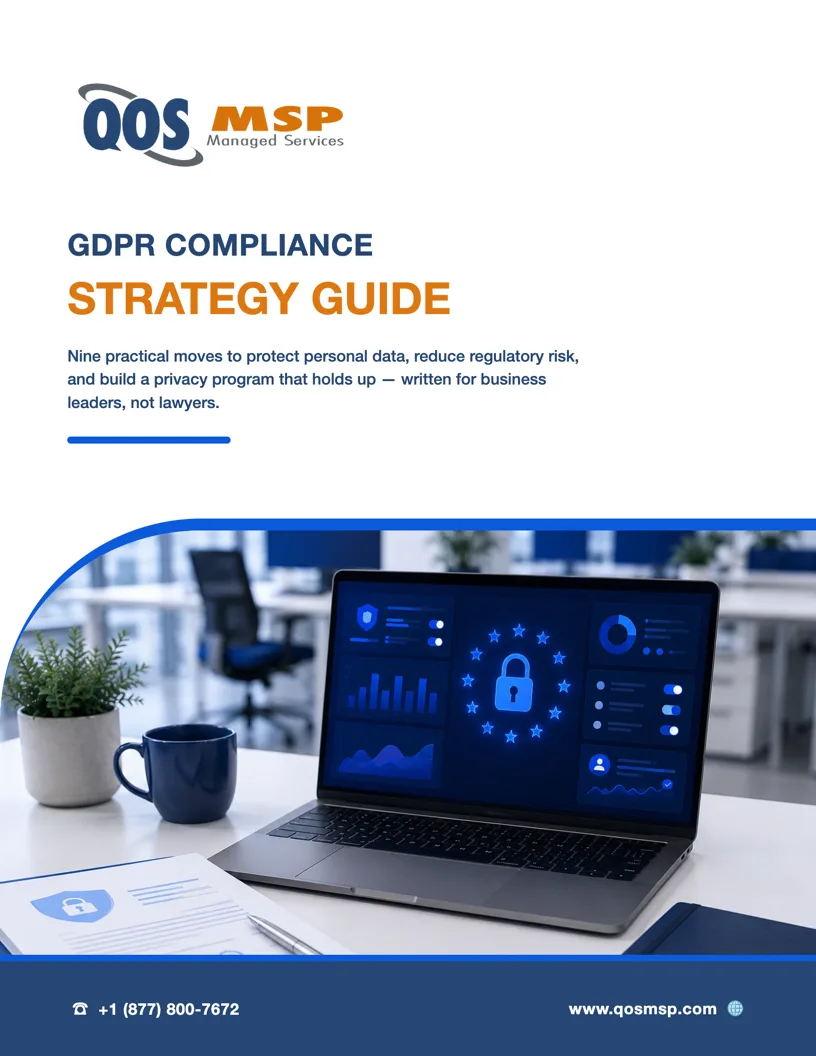
Download the GDPR Compliance Strategy Guide
GDPR has 99 articles; you need a starting point. This guide distills compliance into nine practical moves — data mapping, protection controls, privacy rights, breach readiness — so you can build a program that holds up, without a law degree.
Frequently Asked Questions About GDPR Compliance
-
What is GDPR compliance?
GDPR compliance is the ongoing practice of handling personal data the way the EU's General Data Protection Regulation requires — lawful collection, documented consent, honored privacy rights, and protected storage. For most businesses it comes down to knowing your data and being able to prove you handle it correctly.
-
Does GDPR apply to US companies?
Yes. If you offer goods or services to people in the EU or monitor their behavior — including through website analytics and advertising trackers — GDPR applies regardless of where your company is based. No European office is required.
-
How much do GDPR compliance services cost?
GDPR work is delivered through our Compliance plan at $195 per user per month ($185 on an annual agreement), published in full on our pricing page. One-time projects like a readiness assessment are scoped and quoted up front.
-
What are the penalties for GDPR non-compliance?
Fines run up to €20 million or 4% of global annual revenue, whichever is higher, and regulators can also order you to stop processing data. For US businesses the more immediate cost is usually commercial — EU customers requiring proof of compliance before signing.
-
Do we need GDPR compliance if we have no EU customers?
No. If you don't offer goods or services to people in the EU and don't track EU visitors, GDPR doesn't apply to you — spend your compliance budget on the frameworks that do, like HIPAA or PCI DSS. We'll tell you that plainly in an assessment.
-
What is a Data Protection Officer, and do we need one?
A DPO is a designated privacy lead that GDPR requires only for public authorities and organizations doing large-scale systematic monitoring or large-scale processing of sensitive data. Most US small businesses don't need one — we help you confirm whether you're in scope and cover the function either way.