
About QOS MSP
QOS MSP is the outsourced IT department for Indianapolis-area businesses - managed IT, cybersecurity, cloud, and IT leadership from one accountable team. Part of QOS, delivering IT since 2007.
Contact Info
- PO Box 14, Sheridan, IN 46069
- +1 (877) 800-7672
- info@qosmsp.com
- Monday-Friday, 8:00 AM - 5:00 PM
Outsourced Security Administration
What an Outsourced Security Administrator Covers
The full day-to-day security role — run by a team, not one hire.
24/7 Threat Monitoring
Alerts watched around the clock, with after-hours investigation on a 24×7 agreement.
Endpoint Protection
Bitdefender managed on every device — deployed, tuned, and monitored.
Patch & Vulnerability Management
Security patches prioritized and applied before attackers reach them.
Identity & MFA
Multi-factor enforced, access reviewed, and departing users locked out fast.
Email Security & Awareness
Phishing defense plus training that turns staff into a first line of defense.
Incident Response
A plan and a team ready when something gets through — contain, recover, report.
Hiring a Security Admin In-House vs. Outsourcing the Role
When a questionnaire, an audit, or a near-miss puts security on the agenda, the instinct is to hire. Here's how that one hire compares to covering the same role through your outsourced IT department.
Hiring a security admin in-house
- $95,000–$140,000 a year fully loaded for one role
- One specialist — coverage gaps when they're out
- Protection only during business hours
- Threats evolve faster than one person can track
Outsourcing to QOS MSP
- Flat per-user fee, several IT roles covered
- A team, no single point of failure
- 24/7 monitoring, 24×7 response available
- Current threat intelligence and tooling, always
Security That Runs Every Day — Not Just When You Hire For It
It usually starts with a form. A cyber-insurance questionnaire asks who monitors your systems and enforces MFA, an audit turns up a finding, or a phishing email lands one click too close — and a growing business starts drafting a “Security Administrator” or “Information Security Analyst” job posting. The commitment: $75,000–$110,000 in base salary, $95,000–$140,000 fully loaded once you add taxes, benefits, and tooling.
Here’s what the posting skips: security is a daily operational job, not a one-time project. Threats don’t keep business hours, patches ship every week, alerts fire at 2 a.m., and access has to be reviewed the day someone leaves. It never stops — and it never waits for the one person who owns it to be at their desk.
Almost no business under 75 users generates 40 hours a week of pure security work. But the threats never pause, so you’d pay a specialist salary for what is, most weeks, a part-time load — and one admin is a single point of failure who covers business hours only.
Outsourcing changes the ratio. Security administration becomes one seat in your outsourced IT department — the same flat per-user fee also covers help desk, desktop support, network administration, and system administration. We investigate every alert, not just the red ones, and the work routes to a documented team instead of one person holding the keys. Full tier-by-tier detail is on our pricing page.
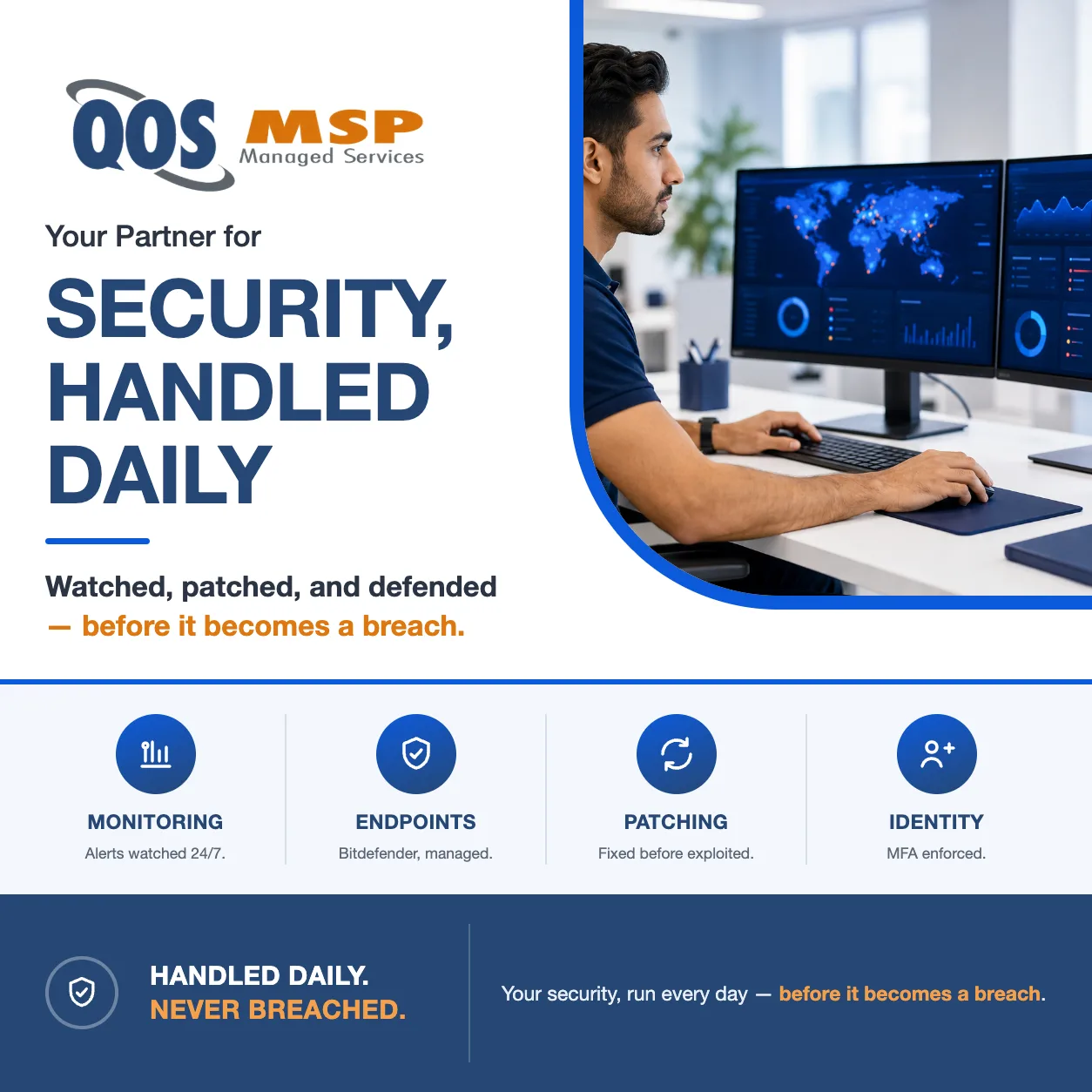
What Is Outsourced Security Administration?
Outsourced security administration is a managed service in which a provider runs a business's day-to-day security operations — threat monitoring, endpoint protection, patching, MFA, access reviews, and incident response — in place of a full-time in-house security administrator. It delivers the security role as a flat monthly service instead of a $95,000–$140,000 salaried hire.
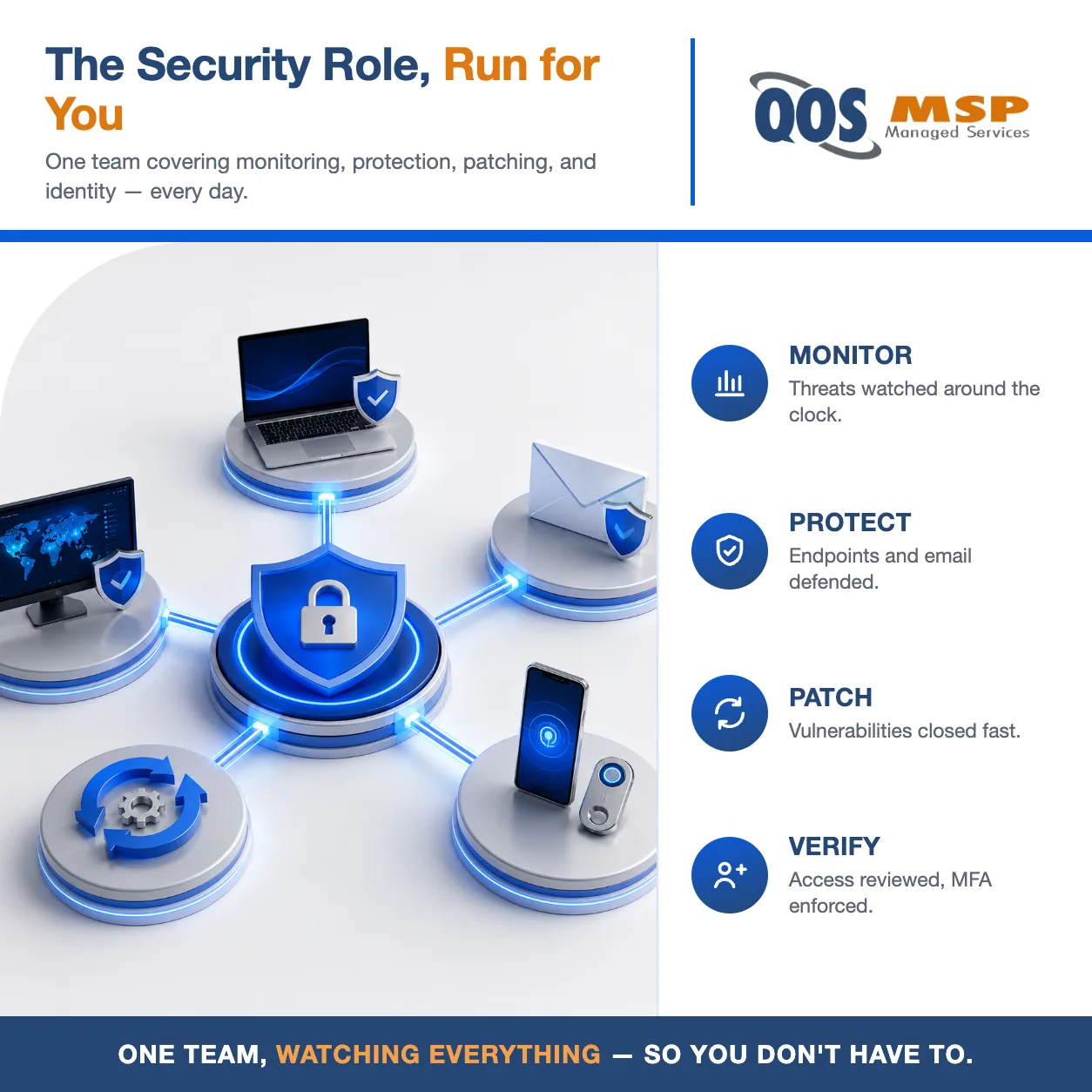
- 24/7 threat monitoring and alerting
- Bitdefender endpoint protection, managed
- Security patch and vulnerability management
- Multi-factor authentication enforcement
- Access reviews and secure offboarding
- Email security and phishing defense
- Security awareness training
- Incident containment and response
One distinction worth drawing: building your security stack — installing firewalls, VPNs, network access control, and intrusion detection — is a quoted project, and that’s our network security services. This page is the ongoing role that runs security every day: the person you’d otherwise hire as a security administrator. That role owns the security layer across everything your network and system administrators keep running.
Why Indianapolis Businesses Choose QOS for Security Administration
We run security the way we'd want it run for our own business: every alert investigated, every device protected, and a local team that already knows your environment when something goes wrong. That's the difference between a tool you bought and a role that's actually covered.
- A full security team, not a single hire
- 24/7 monitoring included from the Core tier up
- Bitdefender, patching, and tested backups as the baseline
- A local Indianapolis team that knows your environment
One clarification businesses ask about: security administration is operational, day-to-day security — it supports, but isn’t, compliance. Passing a SOC 2, HIPAA, or PCI audit is a separate program; that’s our compliance services, which good security administration makes far easier to achieve.
How Much Does Outsourced Security Administration Cost?
A side-by-side look at hiring the role versus outsourcing it, for a typical 25-user Indianapolis office.
| Option | Annual Cost | What You Get |
|---|---|---|
| Hire an in-house security administrator | $95,000–$140,000 loaded ($75,000–$110,000 base) | One specialist, business hours |
| Outsource to QOS MSP (25-user office) | $37,500–$58,500 across tiers | Security admin plus help desk, desktop, network, and system administration |
The pricing model is simple: the per-user fee covers the person, their primary computer, and their mobile device — starting at $125 per user per month on the Core tier ($125 / $165 / $195 across the three tiers), with each additional computer or shared workstation at $35 per month. For a 25-user office that runs $37,500–$58,500 a year — and unlike the salary beside it, that number buys the security-admin role plus help desk, desktop support, network administration, and system administration, not one seat. The security baseline — managed Bitdefender, 24/7 monitoring, and tested backups — is in every tier from Core up, and security-focused buyers often land on the Compliance tier.
Two honest footnotes. The fee is management only — hardware and software licensing are quoted separately at cost, so you’re never paying a markup buried in a bundle. And Bitdefender endpoint security is included on every managed device, not sold as an add-on. Full tier-by-tier detail is on our pricing page.
When Outsourced Security Administration Is the Right Move
Outsourcing the security role isn't right for every organization — but for most small and mid-sized businesses, it covers the same work for a fraction of a full-time salary. Here's when it fits.
- A 10–75-person team with no dedicated security staff
- A cyber-insurance questionnaire you have to answer honestly
- An audit finding or client requirement to close
- A security near-miss that made the risk real
There’s a point where hiring in-house makes more sense: when a contract requires a named, full-time security officer, when you need a 24/7 in-house SOC, or once you pass roughly 150 users with regulated workloads that generate full-time security work. And a straight-talk boundary — QOS MSP covers the security administrator role; we are not a SOC- or SIEM-as-a-service vendor, and no provider can honestly promise zero risk. Short of that, outsourcing puts security in the same department as your network and system administration — covered every day, by a team, for a flat fee.
Download the Outsourced IT Department Buyer's Guide
Deciding whether to hire a security administrator or outsource the role is one call inside a bigger question: how to staff your whole IT department. This guide walks through the core roles, their real loaded costs, and how a single flat per-user fee covers them — so you can right-size the hire-vs-outsource decision before you post the job.
Frequently Asked Questions About Outsourced Security Administration
-
How much does a security administrator cost in Indianapolis?
A full-time security administrator in Indianapolis costs $95,000–$140,000 fully loaded ($75,000–$110,000 base) — the highest-paid of the core IT admin roles. With QOS MSP, the role is included in a flat $125–$195 per user per month fee; a 25-user office runs about $37,500–$58,500 a year, which also covers help desk, desktop support, network administration, and system administration.
-
What is the difference between security administration and network security services?
Security administration is the ongoing role that runs your security day to day — threat monitoring, patching, MFA enforcement, and incident response. Network security services is the project work of designing and installing the security stack: firewalls, VPNs, and intrusion detection. QOS MSP does both.
-
Is security administration the same as compliance?
No. Security administration is operational, day-to-day security. Compliance is meeting a framework and passing an audit — SOC 2, HIPAA, or PCI. The two are related, because strong security administration makes compliance far easier to achieve, but they are distinct programs.
-
What does a security administrator do that a network or system administrator doesn't?
A network administrator keeps connectivity running — switches, firewalls, and VPN. A system administrator keeps servers and applications running. A security administrator owns the security layer across both: monitoring for threats, enforcing MFA, managing endpoint protection, and responding to incidents. QOS MSP covers all three roles in one flat per-user fee.
-
Who responds to a security alert at 2 a.m.?
QOS MSP monitors your environment around the clock, so a 2 a.m. alert is detected and logged the moment it fires — not discovered the next morning. Standard support runs Monday–Friday, 8 a.m. to 5 p.m.; clients with a 24×7×365 support agreement get investigation and response overnight as well. Either way the monitoring never stops — which is exactly what a single in-house administrator working business hours cannot cover.
-
When should a business hire an in-house security administrator instead of outsourcing?
Hire in-house when a contract or regulation requires a named, full-time security officer, when you need a 24/7 in-house SOC, or once you pass roughly 150 users with regulated workloads that generate full-time security work. Below that threshold, outsourcing the role covers the same work without a $95,000–$140,000 salary.