
About QOS MSP
QOS MSP is the outsourced IT department for Indianapolis-area businesses - managed IT, cybersecurity, cloud, and IT leadership from one accountable team. Part of QOS, delivering IT since 2007.
Contact Info
- PO Box 14, Sheridan, IN 46069
- +1 (877) 800-7672
- info@qosmsp.com
- Monday-Friday, 8:00 AM - 5:00 PM
PCI DSS Compliance Services
Core PCI DSS Compliance Services We Provide
Six core services for Indiana businesses that accept, process, or store payment card data.
PCI Readiness Assessment
We map your cardholder data environment, measure controls against PCI DSS 4.0.1, and deliver a prioritized remediation roadmap.
Scope Reduction & Segmentation
Network segmentation and data-flow redesign that shrink your cardholder data environment — smaller scope means faster, cheaper compliance.
Security Control Implementation
Firewalls, MFA, encryption, and hardened configurations that satisfy PCI DSS requirements and actually protect payment data.
Vulnerability Scanning & Testing
Quarterly ASV scans, internal vulnerability scans, and remediation that keep your business continuously scan-compliant.
Policies & Documentation
Written security policies, procedures, and audit evidence organized so your SAQ or QSA assessment goes smoothly.
SAQ & Audit Support
We identify the right SAQ for your setup, complete it with you, and prepare you for QSA assessments when required.
The Cost of Getting Payment Security Wrong
If your business takes card payments, PCI DSS applies to you — and the gap between checkbox compliance and real payment security is exactly where breaches happen.
Without a PCI DSS program
- Unknown card data scattered across systems
- Failed scans and expired SAQs
- Breach liability and card-brand fines
- A compliance scramble every renewal
With QOS managing PCI DSS
- Mapped, minimized cardholder data environment
- Passing quarterly scans, current SAQ
- Reduced breach and fine exposure
- Year-round, audit-ready compliance
Protect Cardholder Data and Keep Customer Trust
Every card swipe, tap, and online checkout hands your business someone’s payment data — and makes you a target. Payment card data remains one of the most attacked data types precisely because it converts directly to money.
The card brands know this, which is why PCI DSS applies to every business that accepts cards — from a single point-of-sale terminal to a national e-commerce operation. Your processor and acquiring bank expect annual validation, and after a breach, the first question asked is whether you were compliant.
Most small and mid-size businesses don’t need more compliance paperwork — they need someone to actually run the security program behind it. That’s what we do: build the controls, keep them working, and keep the evidence current, so validation becomes a formality instead of a fire drill.
What Is PCI DSS Compliance?
PCI DSS compliance is meeting the Payment Card Industry Data Security Standard — the set of security requirements every business that accepts, processes, stores, or transmits payment card data must follow. The current version is PCI DSS 4.0.1, maintained by the PCI Security Standards Council.
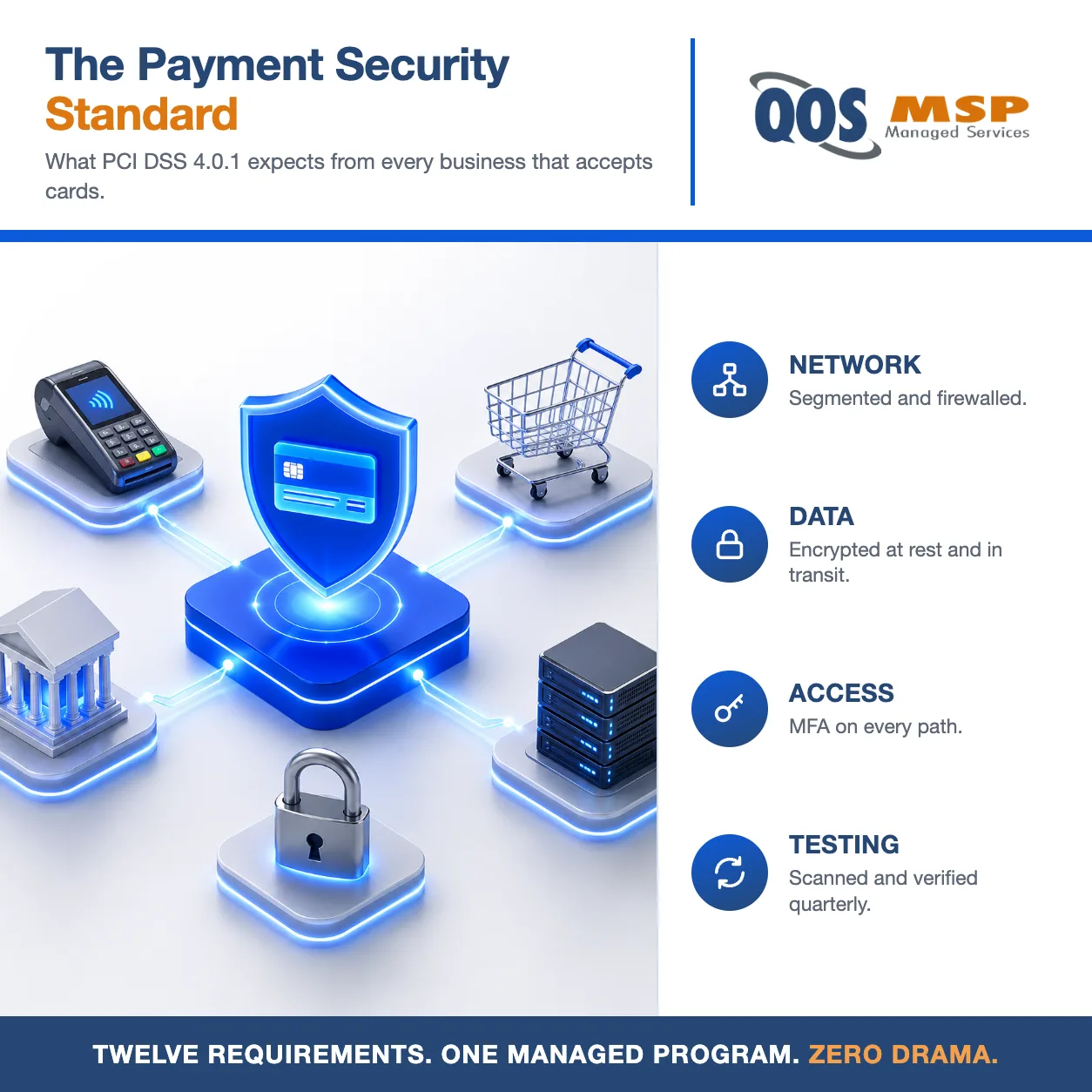
- Network security controls and firewalls
- Secure system configurations
- Protecting stored cardholder data
- Encrypting card data in transit
- Multi-factor authentication and access control
- Vulnerability management and secure software
- Logging and security monitoring
- Regular security testing and scans
Why Indianapolis Businesses Choose QOS for PCI DSS
Plenty of consultants will hand you a gap report and leave. We're a managed service provider — we build the controls, run them every day, and stand behind the evidence.
- One team for IT, security, and compliance
- Flat monthly Compliance-plan pricing
- We operate controls, not just advise
- Local support across Indiana and Chicagoland
Benefits of Managed PCI DSS Compliance
Handled properly, PCI DSS stops being an annual scramble and starts paying for itself.

- Lower risk of cardholder data breaches
- Quarterly ASV scans that pass on schedule
- Faster SAQ completion each year
- No monthly non-compliance fees from your processor
- Smaller compliance scope and lower costs
- Audit-ready evidence and documentation
PCI DSS Support for Every Payment Environment
Wherever cards are accepted, we've secured it — in-store, online, and everywhere between.
- Retail and point-of-sale environments
- E-commerce and online checkout
- Restaurants and hospitality businesses
- Professional offices taking card payments

Download the PCI DSS Compliance Strategy Guide
Not sure where your payment environment stands? This guide walks through scoping your cardholder data environment, the controls PCI DSS 4.0.1 actually requires, choosing the right SAQ, and building a program that stays compliant between validations — in plain business language.
Frequently Asked Questions About PCI DSS Compliance
-
What is PCI DSS compliance?
PCI DSS compliance means your business meets the Payment Card Industry Data Security Standard's requirements for protecting card data — currently version 4.0.1 — and validates it every year, usually through a self-assessment questionnaire (SAQ) and quarterly vulnerability scans.
-
Does PCI DSS apply if we use Stripe, Square, or another payment processor?
Yes. A processor like Stripe or Square dramatically reduces your scope, but never eliminates it — your business still has to protect its side of the payment flow and complete the SAQ your setup requires. Which SAQ that is depends on how card data touches your systems.
-
What are the PCI DSS compliance levels?
Merchant levels 1 through 4, set by your annual card transaction volume. Level 1 — over 6 million transactions a year — requires an annual on-site QSA audit; nearly all small and mid-size businesses fall into levels 2–4 and validate with an SAQ plus quarterly ASV scans.
-
How much does PCI DSS compliance cost?
For most small businesses the direct validation costs are modest — the real cost is remediation and staff time. Our Compliance plan covers the security controls, scanning, and evidence PCI DSS requires at $195 per user per month, or $185 on an annual agreement, with no per-project consulting fees.
-
What happens if my business isn't PCI compliant?
Your processor can add monthly non-compliance fees to your statement, card brands can levy fines through your acquiring bank — commonly cited at $5,000 to $100,000 a month for serious cases — and after a breach, a non-compliant business carries the investigation and liability costs largely alone.
-
Are you a QSA firm?
No. QSA audits must come from an independent, PCI-certified assessor firm. Most businesses we work with never need one — we get you through the right SAQ — and when a QSA is required, we prepare your controls and evidence and work alongside the assessor.