
About QOS MSP
QOS MSP is the outsourced IT department for Indianapolis-area businesses - managed IT, cybersecurity, cloud, and IT leadership from one accountable team. Part of QOS, delivering IT since 2007.
Contact Info
- PO Box 14, Sheridan, IN 46069
- +1 (877) 800-7672
- info@qosmsp.com
- Monday-Friday, 8:00 AM - 5:00 PM
Outsourced Help Desk Services
What Our Help Desk Covers
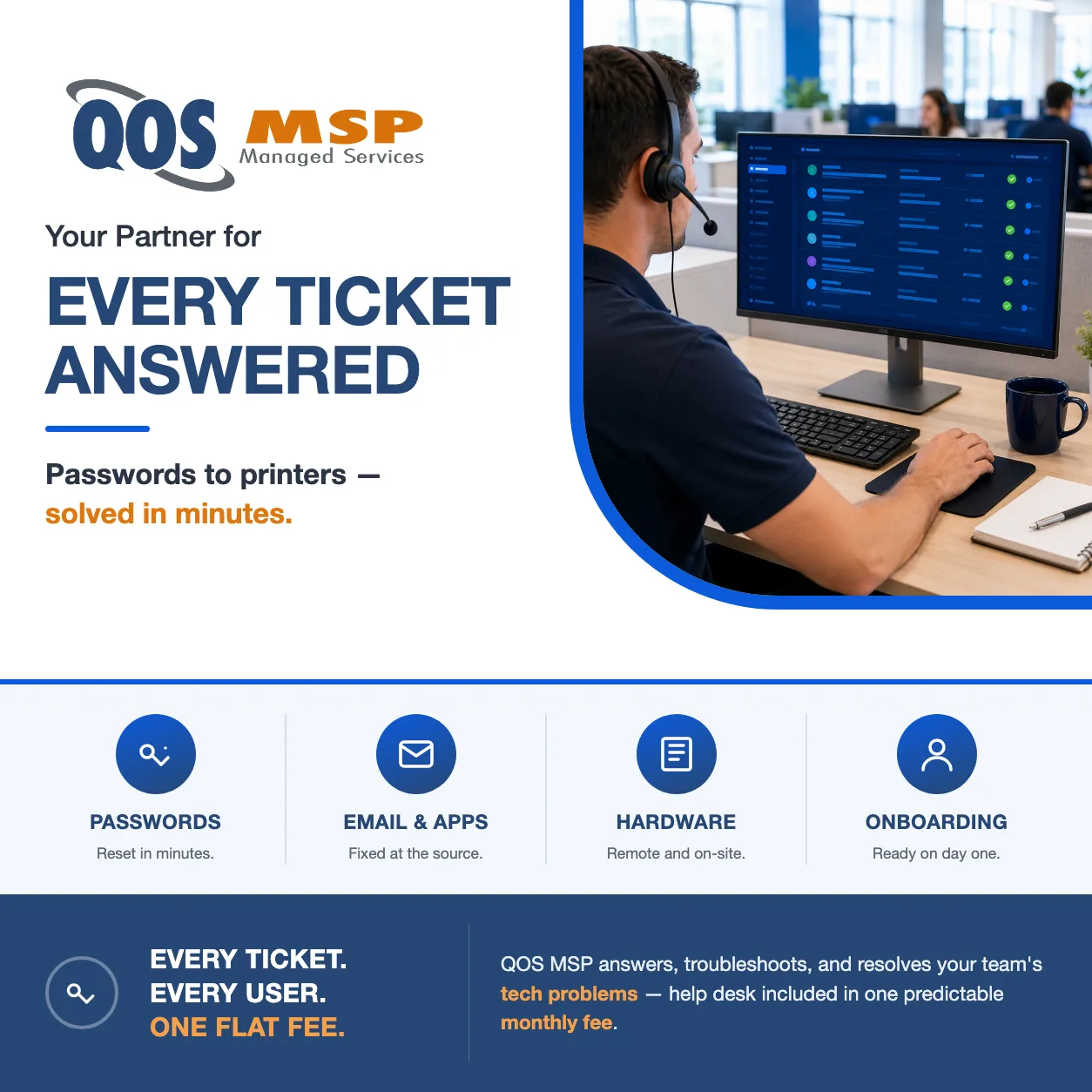
The everyday problems that eat your team's time — handled by people whose whole job is solving them.
Password & Account Issues
Lockouts, resets, and access requests resolved in minutes — the most common ticket there is.
Email & Office Apps
Outlook, Microsoft 365, and Google Workspace problems fixed at the source, not worked around.
Hardware & Printers
Workstations, laptops, and the printer that never behaves — supported remotely and on-site.
Software Troubleshooting
Application errors, updates, and installs handled for every business app you run.
New-User Setup
Onboarding and offboarding — accounts, devices, and access ready on day one.
Escalation to Engineers
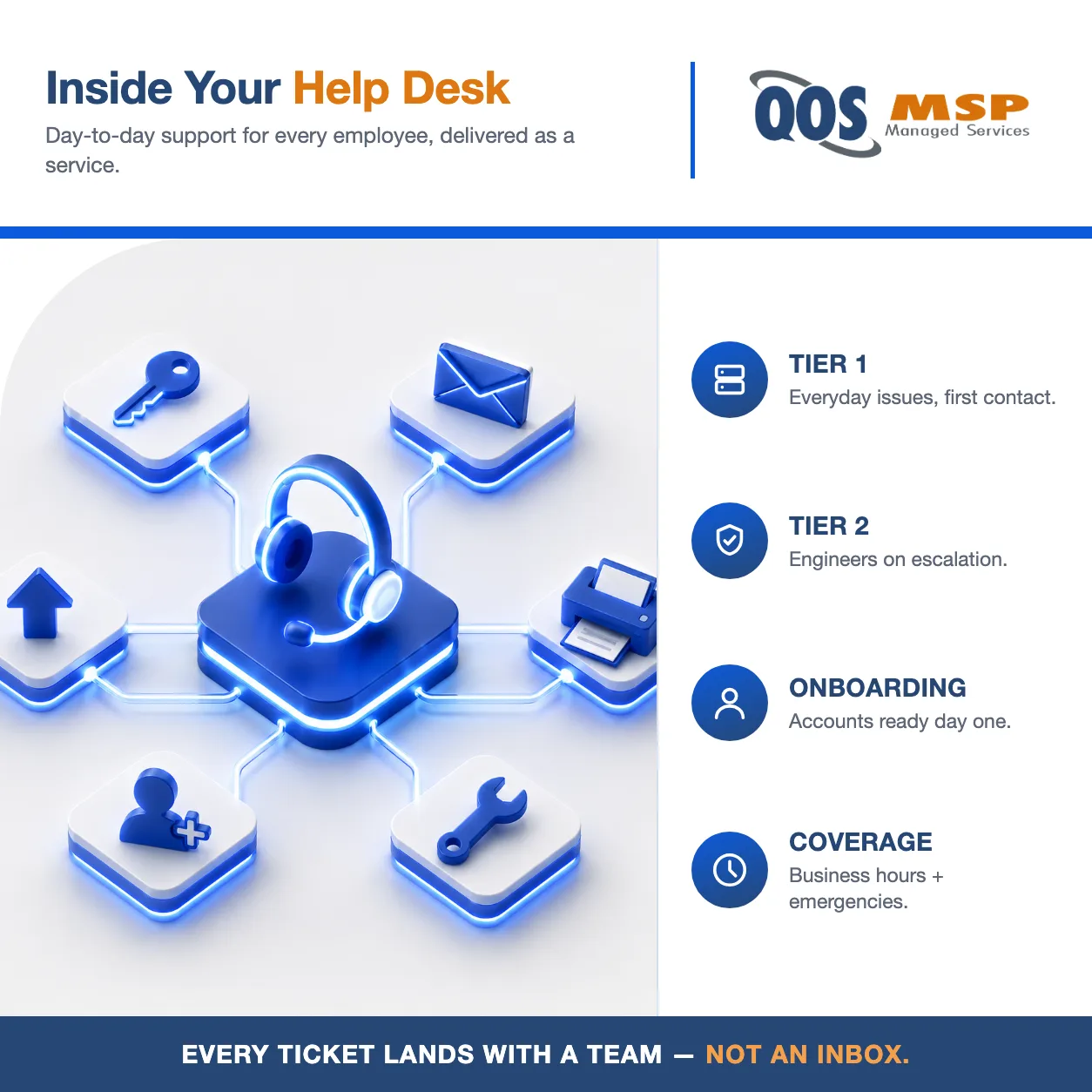
Anything beyond first-contact support goes straight to our engineers — same team, no handoff wall.
Hiring a Support Tech vs. Outsourcing the Help Desk
When ticket volume outgrows whoever has been answering questions on the side, most businesses weigh the same two options.
Hiring one support tech
- $55,000–$78,000 a year, loaded
- One person, forty hours, one queue
- No coverage on sick days and PTO
- Tier 2 problems still need outside help
Outsourcing to QOS
- Included in one flat per-user fee
- A staffed desk, not a single inbox
- Coverage that never takes a day off
- Engineers behind every escalation
The Real Cost of Help Desk Coverage
Help desk is usually the first IT role a growing business tries to hire — the ticket stream is visible, daily, and annoying, so “get someone to handle it” feels obvious. The math is less obvious: one support salary usually costs more than complete IT coverage for the entire company.
| Option | What You Get | Cost / Year |
|---|---|---|
| In-house help desk technician | One person, business hours, help desk only | $55,000–$78,000 loaded |
| Outsourced with QOS MSP | Staffed help desk plus every other IT role | $125–$195 per user/month — $37,500–$58,500 for a 25-person office |
And the outsourced line isn’t just a help desk: the same fee covers system administration, network, security, and IT leadership. The support hire covers exactly one of those — while they’re not on vacation.
What Is Outsourced Help Desk Support?
Outsourced help desk support is a managed service where a provider's support team answers, troubleshoots, and resolves your employees' day-to-day technology problems — replacing or supplementing an in-house support hire for a flat monthly fee.
- Unlimited support requests per user
- Remote troubleshooting and repair
- Password and account management
- Microsoft 365 and Google Workspace support
- Hardware and printer support
- Software installs and updates
- New-employee onboarding and offboarding
- Escalation to systems and network engineers
Why Indianapolis Businesses Outsource Their Help Desk to QOS
A help desk is only as good as the experience your least-technical employee has with it.
- The same familiar team on every call
- Remote fixes in minutes, on-site when needed
- Plain-English answers, not ticket jargon
- Founder-led accountability since 2007
Benefits of an Outsourced Help Desk
The payoff is lost-time math: every unresolved tech problem is an employee not working.
- Faster resolutions, less downtime
- Predictable flat monthly support costs
- 24/7 emergency coverage available
- No hiring or turnover risk
- Every issue tracked and documented
- Happier, more productive employees
When Outsourcing Your Help Desk Makes Sense
The trigger is almost always the same: tech questions are eating someone's whole day.
- The office manager became tech support
- Ticket backlogs are stalling real work
- Your IT admin can't get project work done
- You're dreading posting the support-tech job

Download the Outsourced IT Department Buyer's Guide
Weighing a support hire against outsourcing? This guide breaks down role-by-role hiring costs — help desk included — what an outsourced IT department covers, and an honest hire-vs-outsource framework, with the cases where hiring wins.
Frequently Asked Questions About Outsourced Help Desk Support
-
What is outsourced help desk support?
It's day-to-day employee tech support — answering questions, fixing problems, managing accounts — delivered by a provider's staffed team instead of an in-house hire. Your staff gets a number to call and a team that picks up.
-
How much does an outsourced help desk cost compared to hiring?
A full-time help desk technician runs $55,000–$78,000 a year loaded. Outsourced help desk support is included in QOS MSP's $125–$195 per-user monthly fee — for a 25-person office, the entire IT service typically costs less than that one hire.
-
What's the difference between Tier 1 and Tier 2 support?
Tier 1 handles everyday issues resolved on first contact: passwords, email, printers, software questions. Tier 2 is deeper technical work — system, network, and configuration problems — handled by engineers. With QOS both tiers are the same team under the same flat fee.
-
Can a small business outsource just the help desk?
Yes. Help desk is the most common starting point, and it stands alone as a service. Most clients add roles over time once the support experience proves itself.
-
Do you use an overseas call center?
No. Support comes from our US-based team in the Indianapolis and Chicago areas — your employees talk to the same people every time, not a script.
-
What happens to problems the help desk can't solve?
They escalate to our own systems and network engineers — same company, same flat fee. Nothing gets bounced to a third party or left sitting in a queue.