
About QOS MSP
QOS MSP is the outsourced IT department for Indianapolis-area businesses - managed IT, cybersecurity, cloud, and IT leadership from one accountable team. Part of QOS, delivering IT since 2007.
Contact Info
- PO Box 14, Sheridan, IN 46069
- +1 (877) 800-7672
- info@qosmsp.com
- Monday-Friday, 8:00 AM - 5:00 PM
Fractional IT Leadership Services in Indianapolis
What a Fractional IT Leader Handles
Six executive responsibilities Indianapolis businesses hand to a part-time CIO or CTO instead of a full-time hire.
IT Strategy & Roadmap
A multi-quarter technology plan tied directly to your business goals.
Technology Budget Planning
IT spend categorized, forecast, and right-sized before you commit.
Governance, Risk & Security Oversight
Compliance and security governed by an accountable owner, not left to chance.
Vendor & Contract Management
Renewals, negotiations, and vendor relationships managed to a strategy.
Architecture & Build-vs-Buy
Clear decisions on what to build, what to buy, and how it fits together.
Development & DevOps Oversight
Development standards and DevOps practices set up and directed.
Why Not Just Hire a Full-Time IT Executive?
A full-time CIO or CTO is the obvious answer until you price it. For most growing businesses, the math and the timeline favor a fractional model.
Hiring a Full-Time IT Executive
- Over $200K in salary and benefits
- Months-long executive search
- One person, one skillset
- Hard to right-size the role
Fractional IT Leadership
- Predictable monthly engagement
- A leader in place within weeks
- CIO and CTO expertise on tap
- Scale hours up or down anytime
Executive Technology Direction Without the Executive Salary
Most companies hit a point where technology decisions outgrow the people making them. The network runs and tickets get closed, but nobody owns the roadmap, the budget, or the call on what to build versus buy.
That gap is expensive in quiet ways: overlapping tools, surprise renewals, stalled projects, and risk nobody is accountable for. A full-time executive would close it — but a $200,000-plus hire is out of proportion to the need.
Fractional IT leadership solves it directly. You get a seasoned CIO or CTO on your leadership team part-time, setting direction and owning outcomes, for a predictable monthly fee. It’s one branch of our broader outsourced IT department — the layer that decides, above the layer that runs and builds.
QOS MSP provides both leadership roles, so the seat is filled by the right executive for the problem you actually have.
What Is Fractional IT Leadership?
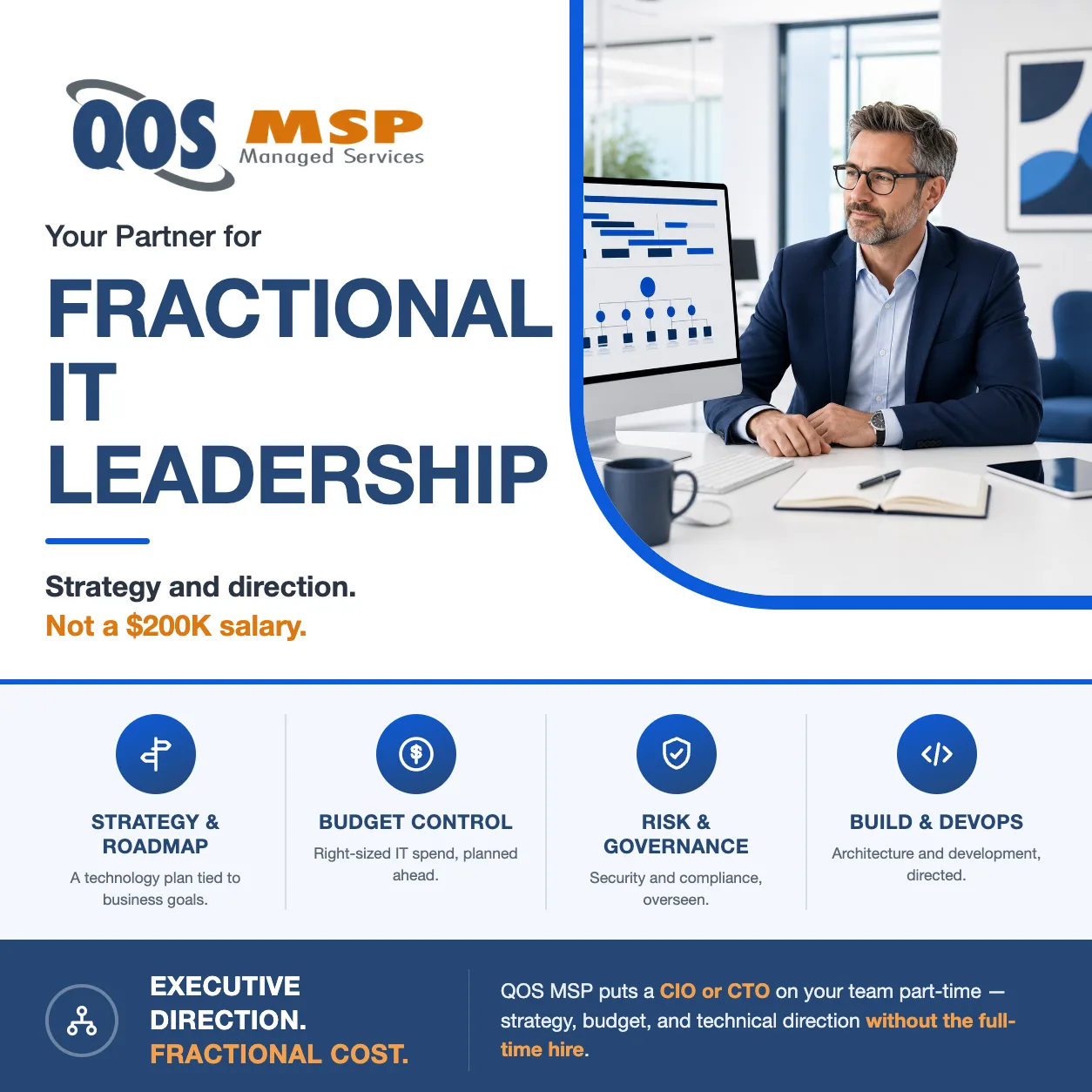
Fractional IT leadership is part-time access to an executive technology leader — a Chief Information Officer or Chief Technology Officer — who sets strategy and owns technology decisions without the cost or commitment of a full-time hire. It's bought by the month and scaled to how much direction your business needs.
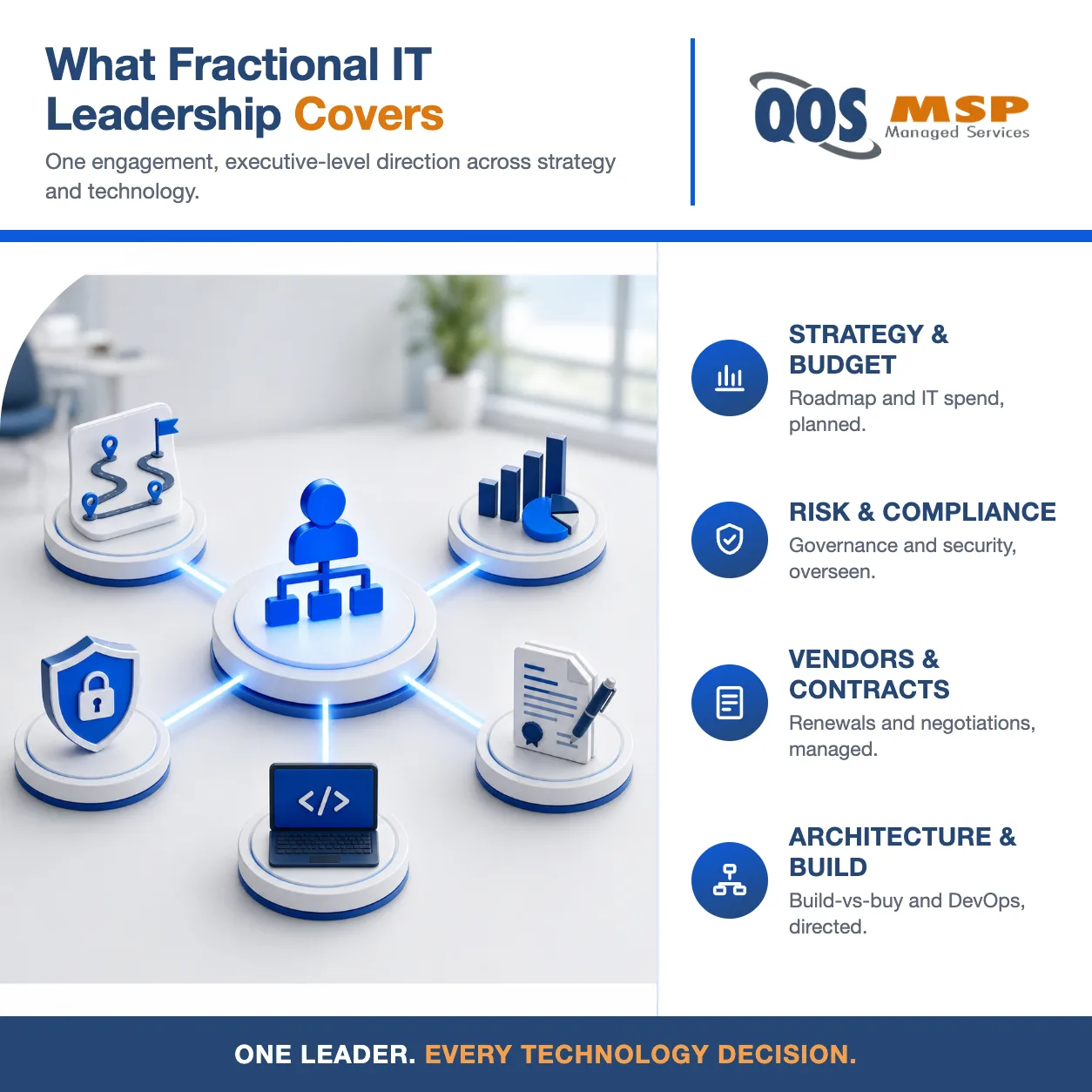
- Technology strategy and multi-quarter roadmap
- IT budget planning and spend forecasting
- Governance, risk, and security oversight
- Vendor, contract, and renewal management
- Architecture and build-vs-buy decisions
- Development and DevOps oversight
- Technology hiring and team structure
- Executive reporting to owners and the board
| Factor | Fractional CIO | Fractional CTO |
|---|---|---|
| Focus | Internal IT strategy & operations | Technology direction & development |
| Owns | Roadmap, budget, governance, vendors, risk | Architecture, build-vs-buy, development & DevOps oversight |
| Best for | Aligning IT to business goals, controlling spend, compliance | Building & scaling software, technical decisions |
| Typical buyer | Ops-heavy SMB modernizing IT | Product- or software-driven company |
| The QOS page | Fractional CIO Services → | Fractional CTO Services → |
Why Indianapolis Businesses Choose QOS for Fractional IT Leadership
The fair criticism of fractional leadership from an IT company is that the "vCIO" exists to sell more of the company's own stack. Part of QOS — delivering IT since 2007, nearly two decades — we built our model to answer that head-on, with clear separation between the leader who advises and the teams who deliver.
- Independent advice, not a sales channel
- Three separate layers: Direct › Run › Build
- Take the leadership without the managed services
- Nearly two decades of IT leadership experience

Benefits of Fractional IT Leadership
You get the caliber of technology leadership a large enterprise pays a full salary for — on a budget that fits a growing business.

- $200K-caliber expertise on a fractional budget
- A technology roadmap tied to revenue goals
- Controlled, forecastable IT spending
- Governance, risk, and compliance ownership
- Objective build-vs-buy and vendor decisions
- Leadership in weeks, not a months-long search
When Fractional IT Leadership Makes Sense
Fractional leadership fits companies with real technology decisions to make but no executive to make them. If you have fewer than about ten users and few decisions on the table, you likely need hands-on support, not a strategist.
- Rapid growth outpacing IT decisions
- Unpredictable, unmanaged technology spend
- A software build needing technical direction
- Compliance or security with no clear owner


Download the Fractional IT Leadership Buyer's Guide
Not sure whether you need a fractional CIO or a CTO — or what a fair engagement costs? This guide walks you through the decision tree, the two roles, engagement models, market-rate benchmarks, and the exact questions to ask before you hire. Everything a business leader needs to choose well, in one document.
Frequently Asked Questions About Fractional IT Leadership
-
What is fractional IT leadership?
Fractional IT leadership is part-time access to an executive technology leader — a CIO or CTO — who sets strategy, owns the IT budget, and directs major technology decisions without being a full-time employee. It's bought as a monthly engagement and scaled to how much direction a business needs, typically $3,000–$8,000 per month.
-
Do I need a fractional CIO or a fractional CTO?
Choose a fractional CIO if your priority is internal IT — strategy, budget, governance, risk, and vendors — as an ops-heavy business modernizing its technology. Choose a fractional CTO if you build software or a product and need architecture, build-vs-buy, and development or DevOps direction. A CIO runs the technology you use; a CTO directs the technology you build. QOS MSP provides both.
-
How much does fractional IT leadership cost?
Fractional IT leadership typically costs $3,000–$8,000 per month, set by the hours and scope of the engagement rather than a per-seat plan. Light-touch advisory runs toward the lower end; active leadership with budget ownership and standing meetings runs higher. Over a year that's roughly $36,000–$96,000 — a fraction of the $180,000–$250,000+ salary a full-time CIO or CTO commands.
-
What's the difference between a fractional CIO and a vCIO?
The terms overlap — "fractional CIO" and "vCIO" (virtual CIO) both describe a part-time technology executive. The real question is independence. A vCIO bundled free into a managed-services contract is often there to sell more of that provider's services. QOS keeps leadership separate from delivery, so the advice serves your best decision, not our largest invoice.
-
How many hours a week does a fractional IT leader work?
Most fractional IT leadership engagements run about 8 to 16 hours a week, adjusted to the workload. A steady-state advisory relationship sits at the lower end; an active period — a migration, a build, or a budget cycle — scales up, then settles back down. You're buying judgment and accountability, not a fixed headcount.
-
Can fractional IT leadership work alongside our in-house IT or existing MSP?
Yes. A fractional CIO or CTO sits above day-to-day IT, setting direction for whoever executes it — your internal staff, your current managed-services provider, or both. The leader owns strategy, budget, and decisions; your existing team keeps handling support and operations, now working to a clear plan.