
About QOS MSP
QOS MSP is the outsourced IT department for Indianapolis-area businesses - managed IT, cybersecurity, cloud, and IT leadership from one accountable team. Part of QOS, delivering IT since 2007.
Contact Info
- PO Box 14, Sheridan, IN 46069
- +1 (877) 800-7672
- info@qosmsp.com
- Monday-Friday, 8:00 AM - 5:00 PM
Cyber Risk Assessment Services
Core Cyber Risk Assessment Services We Provide
Six assessment services for businesses that want facts about their security, not assumptions.
Vulnerability Assessments
We scan systems, devices, and applications for exploitable weaknesses — and validate which ones actually matter.
Security Gap Analysis
We compare your current controls against proven security frameworks and flag exactly what's missing.
Infrastructure Risk Review
Networks, servers, cloud platforms, and endpoints reviewed for misconfiguration and operational risk.
Threat Analysis
We model the attack scenarios most likely to hit your business and how well you'd hold up.
Risk Prioritization & Reporting
Every finding ranked by likelihood and business impact in a plain-English report.
Remediation Planning
A practical, sequenced fix plan we can execute with you or hand to your team.
What Changes After a Cyber Risk Assessment
Most businesses don't lack security tools — they lack visibility into whether those tools cover the risks that matter. That's the gap an assessment closes.
Without a risk assessment
- Unknown gaps attackers find first
- Security spending driven by guesswork
- Surprises during audits and insurance reviews
- Improvised response when incidents hit
With a QOS assessment
- Every gap found, ranked, and owned
- Budget aimed at the biggest risks
- Evidence ready for auditors and insurers
- A clear remediation and response plan
Find Your Security Gaps Before Attackers Do
Most breaches don’t start with sophisticated zero-day exploits. They start with known weaknesses — an unpatched server, a stale account with too much access, a backup nobody ever tested. Attackers don’t need to be clever when the basics are open.
Meanwhile, the environment keeps growing: cloud platforms, remote workers, third-party vendors, and years of accumulated systems. Every addition is useful — and every one widens the surface where risk can hide.
A cyber risk assessment turns that uncertainty into a ranked list. You learn what’s exposed, what it would cost you if it failed, and what to fix first — so security decisions become budget decisions you can actually defend.
We’ve been running IT environments since 2007, and we assess the way practitioners do: hands-on, against your real systems, with fixes in mind — not a compliance checkbox exercise.
What Is a Cyber Risk Assessment?
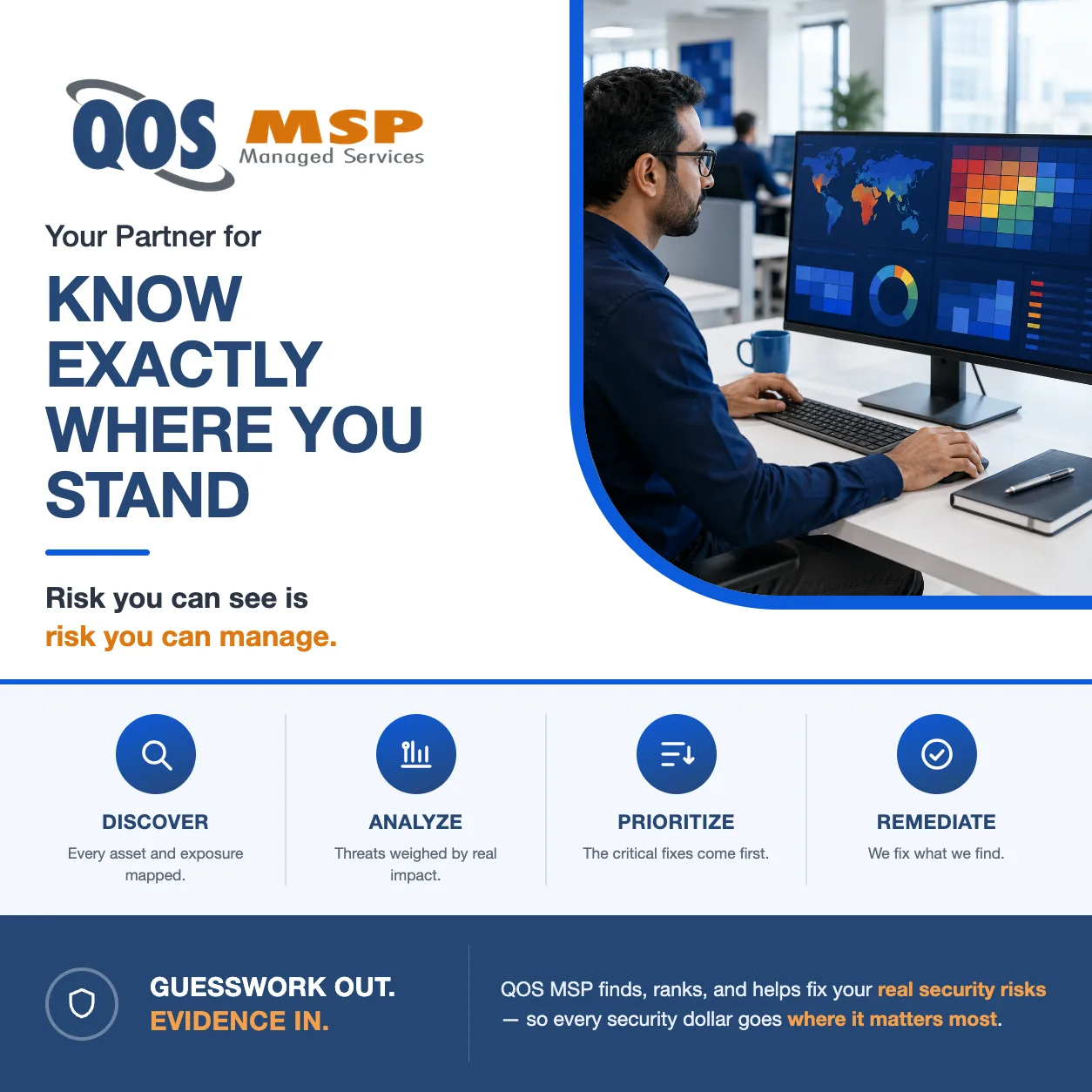
A cyber risk assessment is a structured review of your technology environment — systems, data, controls, and users — that identifies security weaknesses, weighs their likelihood and business impact, and ranks them so you know exactly what to fix first. Unlike a simple scan, it puts every finding in business context: what it touches, what it would cost, and how urgent it really is.
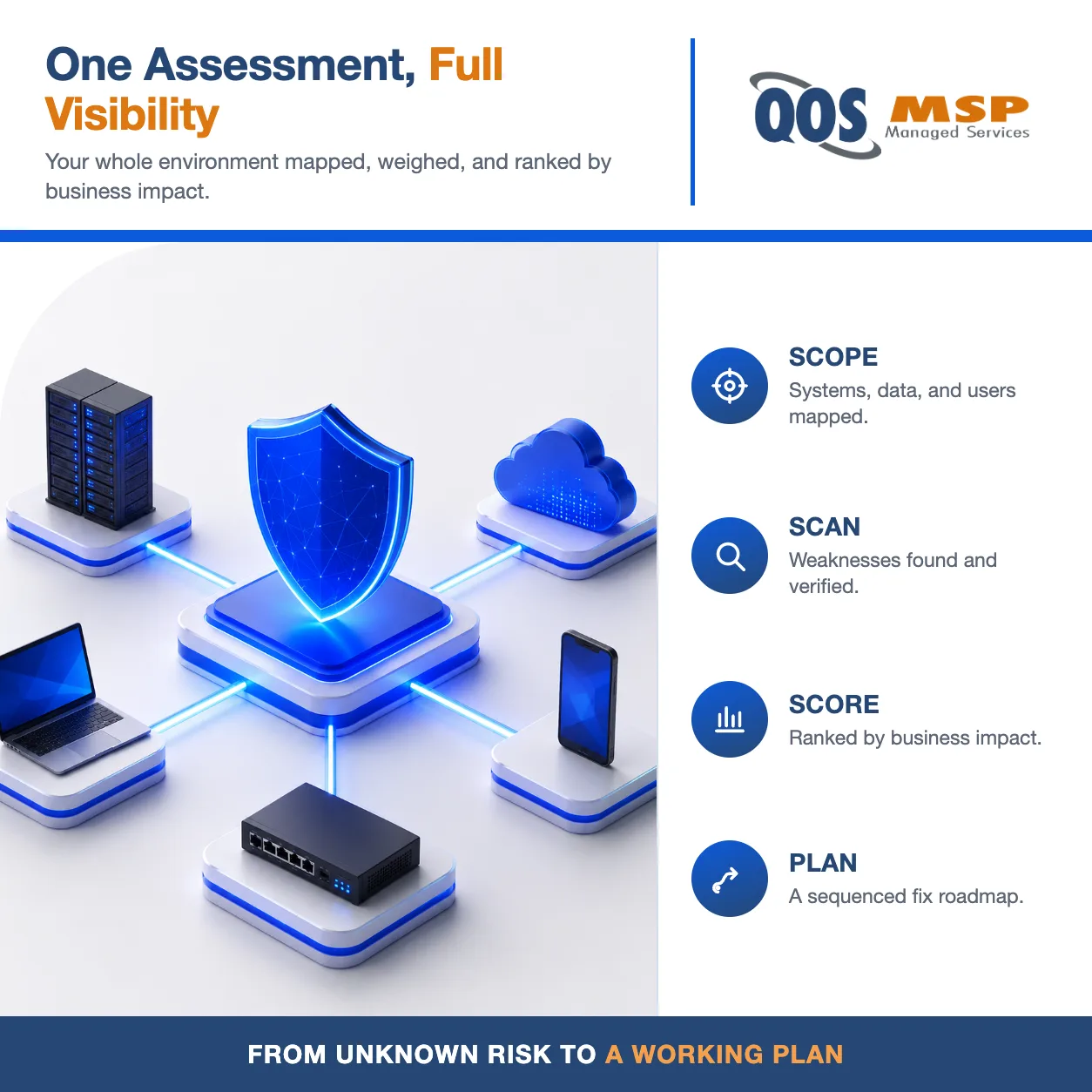
- Network and firewall configuration
- Servers and cloud environments
- Workstations and mobile endpoints
- Identity and access management
- Backup and recovery readiness
- Security policies and procedures
- Email and phishing exposure
- Existing security controls
Why Indianapolis Businesses Choose QOS for Cyber Risk Assessments
Plenty of firms will sell you a scan and a thick PDF. We assess the way people who run IT for a living assess — and we stay for the fixes.
- Assessors who run IT environments daily
- Plain-English, risk-ranked reporting
- Fixed-scope, flat-fee engagements
- Hands-on remediation after the report

Benefits of a Professional Cyber Risk Assessment
The assessment pays for itself in avoided incidents — but the day-to-day benefits show up faster.

- Fewer exploitable vulnerabilities
- Lower breach and downtime risk
- Smarter, targeted security spending
- Evidence for cyber-insurance applications
- Audit-ready security documentation
- A prioritized remediation roadmap
When to Schedule a Cyber Risk Assessment
An assessment is valuable any time — but some moments make it urgent.
- Applying for or renewing cyber insurance
- Preparing for HIPAA, SOC 2, or PCI audits
- After a security incident or near miss
- Taking on a new IT provider or platform

Download the Cyber Risk Assessment Strategy Guide
Not sure where your security program stands? This five-page guide walks through the six steps of a practical cyber risk assessment — identifying critical assets, evaluating threats, measuring business impact, and prioritizing fixes — so you can start reducing risk before an incident forces the issue.
Frequently Asked Questions About Cyber Risk Assessments
-
What is a cyber risk assessment?
A cyber risk assessment is a structured review of your systems, data, and security controls that identifies weaknesses and ranks them by likelihood and business impact. The result is a prioritized fix plan — security decisions based on measured risk instead of guesswork.
-
How much does a cyber risk assessment cost?
It depends on the size and complexity of your environment — we scope every assessment as a fixed-fee project, so the price is known before work starts. For managed-IT clients, our Compliance plan ($195 per user/month) includes recurring risk assessments.
-
What's the difference between a cyber risk assessment and a penetration test?
A risk assessment evaluates your whole security posture — controls, configurations, policies, exposure — and ranks risks by business impact. A penetration test actively tries to exploit specific weaknesses to prove they're breakable. Most organizations need the assessment first: it tells you where a pen test is even worth aiming.
-
How often should we do a cyber risk assessment?
At least annually, and after any major change — a cloud migration, an acquisition, new business-critical systems, or a security incident. Many compliance frameworks and cyber-insurance policies expect an annual assessment.
-
What do we receive at the end of the assessment?
A plain-English report listing every identified risk, its likelihood and business impact, and a prioritized remediation roadmap. We walk you through the findings and can execute the fixes with you — it's a work plan, not a shelf document. When the fixes involve the network edge — firewall, VPN, segmentation — that build is our network security services.
-
We already have a firewall and antivirus — do we still need a risk assessment?
Yes. Tools protect against the risks they're pointed at; an assessment tells you whether they're pointed at the right ones. Most weaknesses we find — stale accounts, missing patches, untested backups, over-broad access — sit behind a working firewall.