

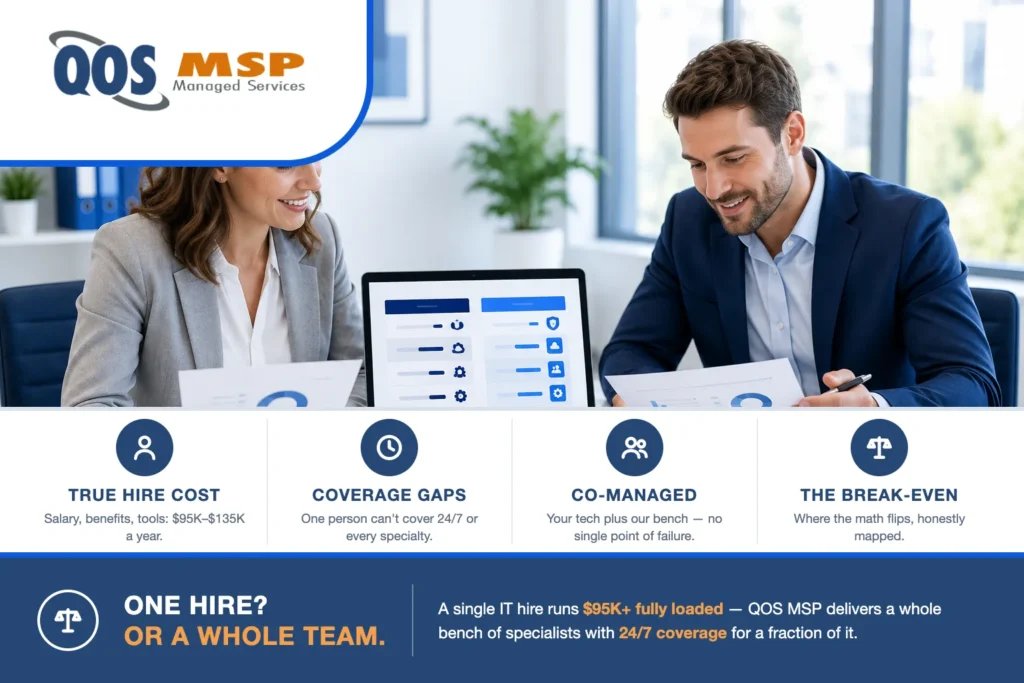
For most Indianapolis businesses under about 75 employees, managed IT costs one-third to one-half of what a single in-house IT hire really costs — and covers more hours with more specialties. That’s the short version. But “just hire an IT person” is sometimes the right answer, and this comparison is only useful if it’s honest about when. Here’s the full math.
What does one IT hire really cost?
An experienced IT generalist in the Indianapolis market runs $60,000–$80,000 in salary. Loaded cost is what your books actually feel:
- Salary: $60,000–$80,000
- Benefits, payroll taxes, insurance: +25–35% → roughly $80,000–$105,000
- Tools they’ll need to do the job (monitoring, ticketing, security, backup licensing): $10,000–$25,000/year — the software an MSP already owns
- Training and certifications to stay current: $2,000–$5,000/year
- Recruiting and turnover: IT staff move often in this market, and every departure costs a hiring cycle plus months of undocumented-knowledge loss
| Factor | One in-house hire | Managed IT (~30 users) |
|---|---|---|
| Annual cost | $95K–$135K loaded | ~$40K–$80K |
| Coverage | 40 hrs/week, one person | 24/7 monitoring + help desk |
| Expertise | One generalist | Bench of specialists |
| Single point of failure | Yes | No |
| Tools/licensing | +$10K–$25K/yr on top | Included |
Realistic total: $95,000–$135,000 a year for one person — who works 40 hours a week, takes vacations, gets sick, and cannot be an expert in networking, security, cloud platforms, and compliance simultaneously. The single point of failure is the part businesses underestimate: when your one IT person resigns, everything they knew walks out the door with them.
What the same budget buys in managed IT
At typical Indianapolis rates ($110–$225 per user per month — our full pricing guide breaks this down), a 30-person company pays roughly $40,000–$80,000 a year for managed IT. For that it gets a help desk that doesn’t take vacations, 24/7 monitoring, a security stack no single hire can match, tested backups, and access to specialists — the network person, the cloud person, the compliance person — as the situation demands. No recruiting, no turnover risk, no tool licensing on your books.
When does in-house IT genuinely win?
- You need hands on hardware daily — manufacturing floors, warehouses with constant device churn, environments where physical presence is the job.
- You’re past ~75–100 employees — the math starts favoring a first internal hire, usually paired with an MSP behind them.
- You run genuinely custom systems that demand full-time institutional knowledge — a proprietary line-of-business platform nobody outside could learn part-time.
If one of those is you, hire — sincerely. The mistake isn’t hiring in-house; it’s hiring one generalist and expecting enterprise coverage from a single human.
The hybrid most growing companies actually land on
Co-managed IT: your internal person handles the daily hands-on work and knows the business cold; the MSP carries monitoring, security, backups, and the specialties. It removes the single point of failure without duplicating anyone’s job, and it’s usually how the in-house-vs-managed question resolves once a company hits the size where it stops being either/or.
Frequently asked questions
How much does an in-house IT person cost in Indianapolis?
$60K–$80K in salary; $95K–$135K fully loaded once benefits, tools, training, and turnover are counted.
At what size should a business hire in-house IT?
Usually past 75–100 employees — and typically paired with an MSP (co-managed) rather than replacing one.
What is co-managed IT?
A split model: your internal tech handles daily hands-on work while the MSP carries monitoring, security, backups, and specialist coverage — removing the single point of failure.
How to decide
Count your employees, list your compliance obligations, and ask what happens today if your most technical person disappears for two weeks. Under 50 employees with standard business systems, managed IT wins the math almost every time. Past that, it’s a real conversation — and we’re happy to have it honestly, including telling you if a hire is the better call. Talk to us.
