
About QOS MSP
QOS MSP is the outsourced IT department for Indianapolis-area businesses - managed IT, cybersecurity, cloud, and IT leadership from one accountable team. Part of QOS, delivering IT since 2007.
Contact Info
- PO Box 14, Sheridan, IN 46069
- +1 (877) 800-7672
- info@qosmsp.com
- Monday-Friday, 8:00 AM - 5:00 PM
Outsourced Network Administration
What a Network Administrator Does
Six day-to-day network functions Indiana businesses would otherwise hire a specialist to run.
Network Monitoring
Continuous eyes on switches, firewalls, and connectivity, with alerts the moment something degrades.
Configuration Management
Controlled, documented changes to switches, firewalls, and VLANs — nothing altered off the record.
Firmware & Patching
Firmware updates and security patches applied on schedule across every network device.
VPN & Remote Access
Secure VPN tunnels and remote-access accounts set up, maintained, and locked down.
User Access Management
Network permissions provisioned for new hires and revoked the day someone leaves.
Capacity Planning
Bandwidth and performance tracked ahead of demand, so the network scales before it strains.
Hiring a Network Administrator vs. Outsourcing the Role
Most growing businesses hit the point where the network problems seem to justify a dedicated hire. Here is what that decision looks like next to outsourcing the role.
Hiring a network administrator
- $80,000–$120,000 a year fully loaded
- A specialist salary for a part-time workload
- One person — a single point of failure
- Coverage only during business hours
Outsourcing to QOS MSP
- Flat per-user fee, all six IT roles
- A team, not a single hire
- Around-the-clock monitoring, 24×7 response available
- Network administration included in every tier
The Network Needs an Administrator — Not Necessarily a Hire
The network needs an administrator every day — a switch to configure, firmware to patch, a VPN tunnel that drops at the worst moment, a new hire who needs access provisioned before lunch. So a growing business drafts a network-administrator job posting and commits to $65,000–$95,000 in base salary, $80,000–$120,000 fully loaded once you add taxes, benefits, and tools.
Here’s the math the posting skips: almost no business under 50 users generates 40 hours a week of network work. The switches, firewall, and access points run for days without a hand on them; the real load is monitoring, the occasional change, and fast response when something breaks. You pay a specialist salary for what is, most weeks, a part-time job — and one hire is a single point of failure who works business hours only.
Outsourcing flips that ratio. Network administration becomes one seat in your outsourced IT department — the same flat per-user fee also covers help desk, desktop support, system administration, security, and IT leadership. We monitor client networks around the clock, and configuration changes route to our team, not to whoever in the office happens to hold the firewall password.
Since 2007, QOS MSP has run business networks for a flat monthly fee instead of a salaried hire — full tier-by-tier detail is on our pricing page.
What Is Network Administration?
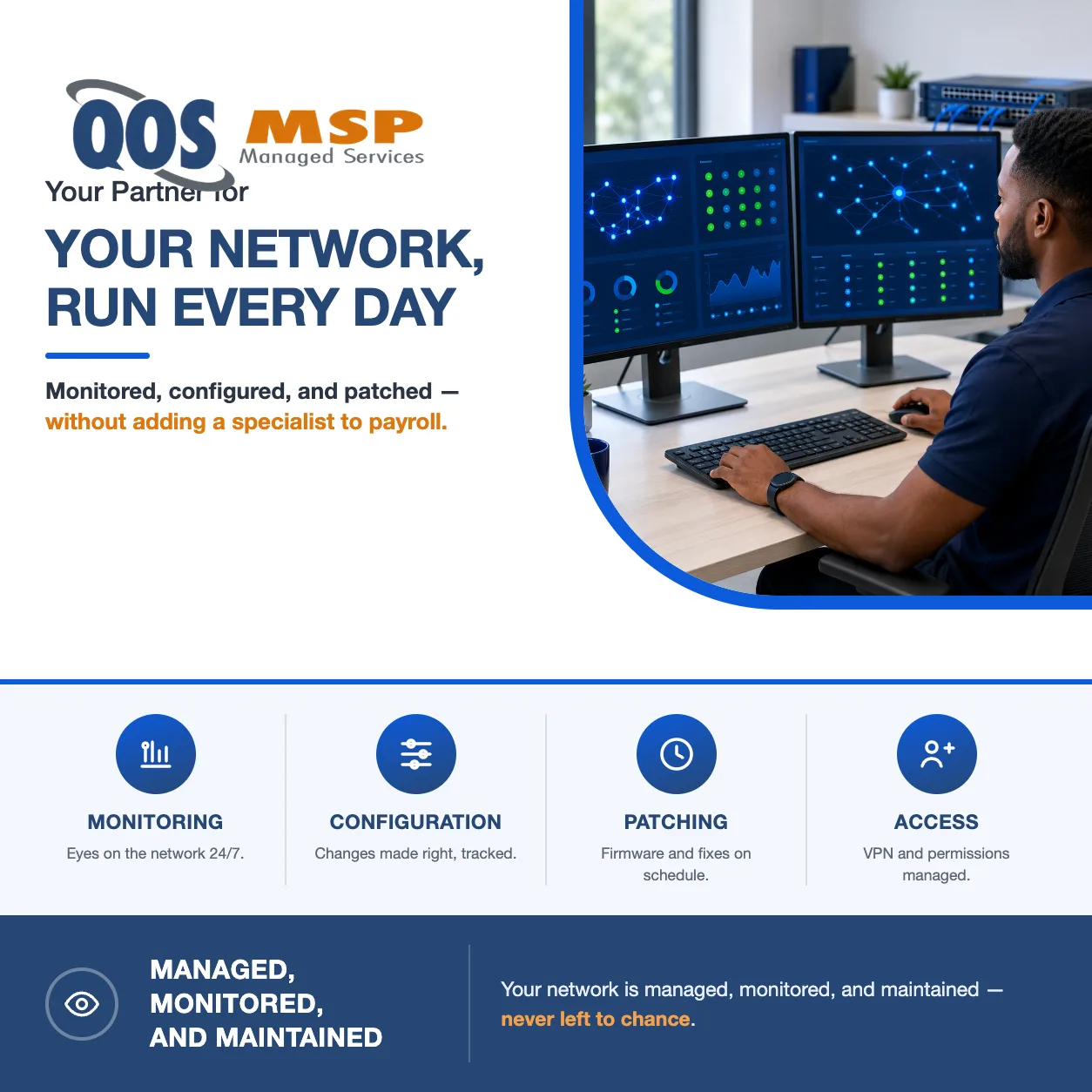
Network administration is the day-to-day operation of an existing business network — its switches, firewalls, VPN, wireless, and internet connectivity — including monitoring, configuration, firmware patching, user access, and troubleshooting, handled for a flat monthly fee by an external provider like QOS MSP.
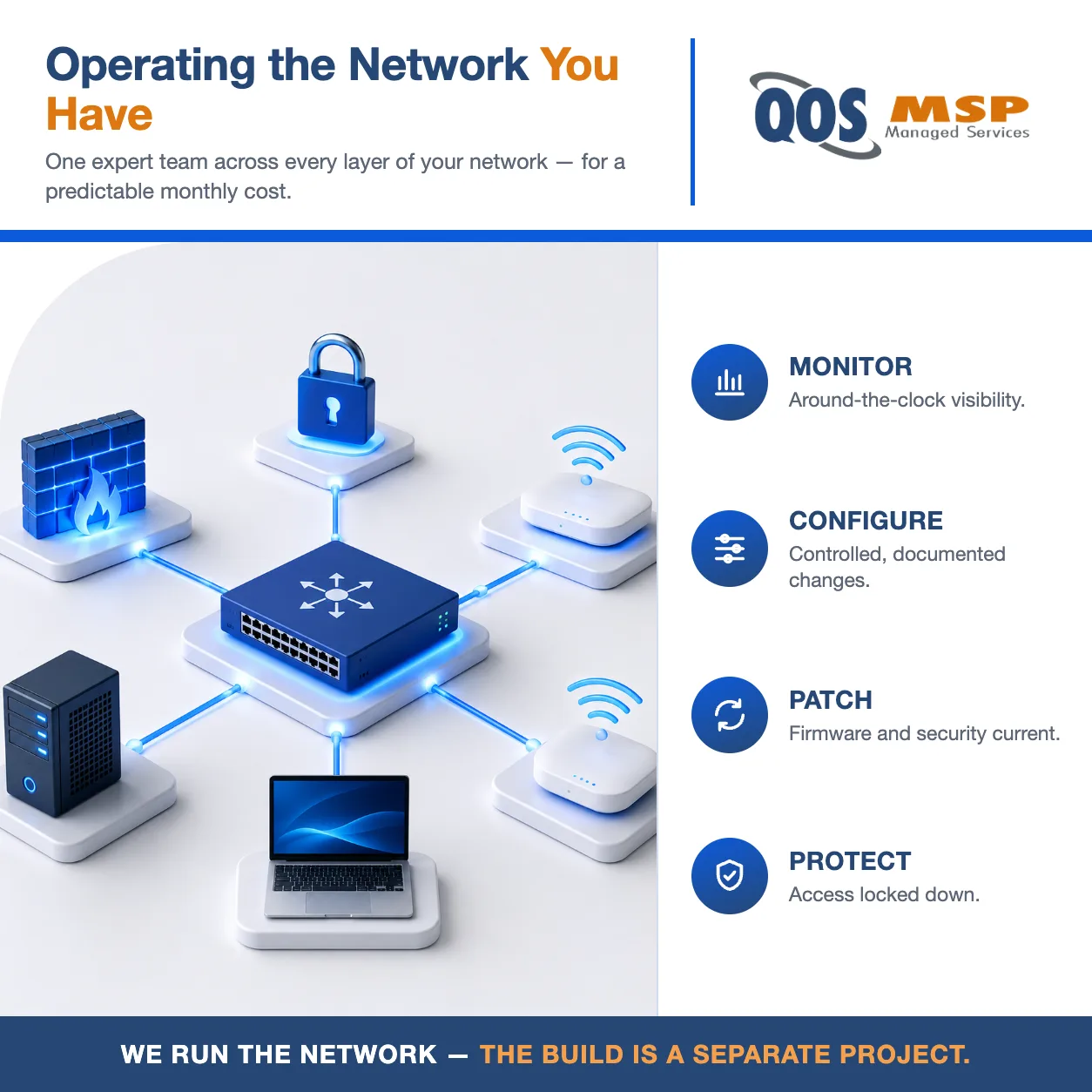
- Configuration management and change control
- 24/7 network monitoring and alerting
- Firmware updates and security patching
- VPN and remote-access administration
- User access and permissions management
- Troubleshooting and incident response
- Capacity planning and performance tuning
- Network documentation and asset tracking
One important distinction: network administration is running the network you already have. Designing and building a network — structured cabling, switches, wireless, and servers — is a quoted project, and that’s our network infrastructure services. This page is about the operate half: the day-to-day role you’d otherwise hire a network administrator to fill.
How QOS MSP Covers the Network Administrator Role for Indianapolis Businesses
We monitor client networks around the clock, and what follows isn't a brochure promise — it's what runs every week across our client base. A network administrator is one job; with QOS MSP it's covered by a team that hands off cleanly to our security-administration group the moment an alert crosses from operations into a threat.
- A team covering the role, not a single hire
- Around-the-clock monitoring and response
- Coordinated handoffs with security operations
- Network administration included in every service tier
The result is a network that’s watched at 2 a.m., not just at 2 p.m. — and when it needs hardening beyond daily administration, that’s our network security services.

How Much Does Outsourced Network Administration Cost?
The honest comparison is a loaded specialist salary against a per-user fee. Here's both, with nothing hidden.
| Option | Annual Cost | What You Get |
|---|---|---|
| Hire an in-house network administrator | $80,000–$120,000 loaded ($65,000–$95,000 base) | One specialist, business hours |
| Outsource to QOS MSP (25-user office) | $37,500–$58,500 across tiers | Network admin plus help desk, desktop, systems, and security |
The pricing model is simple: the per-user fee covers the person, their primary computer, and their mobile device — starting at $125 per user per month on the Core tier ($125 / $165 / $195 across the three tiers), with each additional computer or shared workstation at $35 per month. That’s the 25-user example above: 25 users across the three tiers runs $37,500–$58,500 a year — and unlike the salary beside it, that number buys network administration plus help desk, desktop support, system administration, and security, not one role.
Two honest footnotes. The fee is management only — network hardware and software licensing are quoted separately at cost, so you’re never paying a markup buried in a bundle. And Bitdefender endpoint security is included on every managed device, not sold as an add-on. Full tier-by-tier detail is on our pricing page.
When You Actually Need an In-House Network Administrator
The model fits a specific kind of business — and we'd rather tell you up front when it doesn't.
- Multiple sites or a data center needing a 24/7 in-house NOC
- Constant, hands-on network change every single day
- Compliance requirements mandating dedicated staff
- More than ~100 users on complex, self-managed infrastructure
The honest exception runs the other way, too: if your real problem is a network that was never built right — dropped connections, dead spots, a patch panel nobody documented — you need an infrastructure project first, not an administrator. That’s our network infrastructure services, and we’ll tell you when that’s the actual fix.


Download the Outsourced IT Department Buyer's Guide
Deciding between a network-administrator hire and outsourcing the role is one chapter of a bigger decision. The guide breaks down every IT role — what it costs to hire, what it costs to outsource, and how to build the right mix for a growing business.
Frequently Asked Questions About Outsourced Network Administration
-
What is the difference between network administration and network infrastructure services?
Network administration is running an existing network day to day — monitoring, configuration, firmware patching, VPN, and user access. Network infrastructure services is designing and building that network — structured cabling, switches, wireless, and servers — as a quoted project. QOS MSP does both: administration is the ongoing role, infrastructure is the build.
-
What is the difference between a network administrator and a system administrator?
A network administrator manages the network layer — switches, firewalls, VPN, wireless, and the connectivity between devices. A system administrator manages servers, operating systems, and applications. They overlap, but the network admin keeps traffic flowing while the system admin keeps servers and software running. QOS MSP includes both in one per-user fee.
-
How much does it cost to outsource network administration?
An in-house network administrator costs $80,000–$120,000 a year fully loaded ($65,000–$95,000 base) in Indianapolis. With QOS MSP, network administration is included in the $125–$195 per-user monthly fee — a 25-user office runs about $37,500–$58,500 a year and gets every IT role, not just the network.
-
Does a small business need a full-time network administrator?
Most businesses under 50 users don't generate 40 hours a week of network work — the switches, firewall, and access points run for days without a hand on them. But the network still needs daily administration: monitoring, patching, and fast response. That's why outsourcing the role fits a smaller business better than a full-time hire, which pays a specialist salary for a part-time load.
-
Can QOS administer network hardware we already own?
Yes. QOS MSP's model is management only, so we administer the switches, firewalls, and access points you already own — configuration, monitoring, firmware, and troubleshooting. Replacement or new hardware is quoted separately at cost, with no markup buried in a bundle.
-
What happens when the network goes down after hours?
QOS MSP monitors client networks around the clock, so an outage is detected the moment it happens instead of being discovered in the morning. Standard support runs Monday–Friday, 8 a.m. to 5 p.m.; clients with a 24×7×365 support agreement get after-hours response too. A single in-house administrator works business hours only — after they go home, the network isn't watched at all until they return.