
About QOS MSP
QOS MSP is the outsourced IT department for Indianapolis-area businesses - managed IT, cybersecurity, cloud, and IT leadership from one accountable team. Part of QOS, delivering IT since 2007.
Contact Info
- PO Box 14, Sheridan, IN 46069
- +1 (877) 800-7672
- info@qosmsp.com
- Monday-Friday, 8:00 AM - 5:00 PM
Outsourced System Administration
What Outsourced System Administration Covers
Everything a full-time system administrator would own — run by a team.
Server Administration
Windows Server roles kept patched, monitored, and running day to day.
Microsoft 365 Administration
Tenant, Exchange Online, mailboxes, and licensing managed and secured. Explore managed Microsoft 365 services ›
OS Patching & Updates
Operating-system updates tested and scheduled, so patches stop slipping.
Users & Permissions
Active Directory and Entra ID accounts and access provisioned and revoked.
Backup & Recovery
Backups monitored and restores actually tested — not just assumed.
Business Application Support
Line-of-business applications kept current, integrated, and running.
Running the Role In-House vs. Outsourcing It
Most growing businesses hit the point where the systems work seems to justify a dedicated hire. Here's what that decision looks like next to outsourcing the role.
Running it in-house
- One admin — no coverage when they're out
- Patches slip when they're firefighting
- Backups run, but restores go unverified
- Knowledge walks out the door if they quit
Outsourcing to QOS MSP
- A team covers the role, no single point of failure
- Patching on a schedule, not when time allows
- Backups monitored and restores tested
- A documented environment, continuity guaranteed
The Servers Need Running — But Not Necessarily a Hire
The servers are running, but someone has to keep them that way — Windows updates to test and schedule, mailboxes and licenses to manage, backups to check, an application that needs patching before Monday. So a growing business writes a “System Administrator” job posting and commits to $70,000–$100,000 in base salary, $85,000–$125,000 fully loaded once you add taxes, benefits, and tools.
Here’s what the posting skips: almost no business under 50 users generates 40 hours a week of systems work. Servers run for days without a hand on them; the real load is monitoring, scheduled patching, verified backups, and fast response when something breaks. You’d pay a specialist salary for what is, most weeks, a part-time job — and one admin is a single point of failure who works business hours only and takes the environment’s knowledge with them if they leave.
Outsourcing changes the ratio. System administration becomes one seat in your outsourced IT department — the same flat per-user fee also covers help desk, desktop support, network administration, security, and IT leadership. We patch, monitor, and verify restores every week across our client base, and administration routes to a documented team, not to whoever holds the server password.
Since 2007, QOS MSP has administered business servers for a flat monthly fee instead of a salaried hire — full tier-by-tier detail is on our pricing page.
What Does a System Administrator Do?
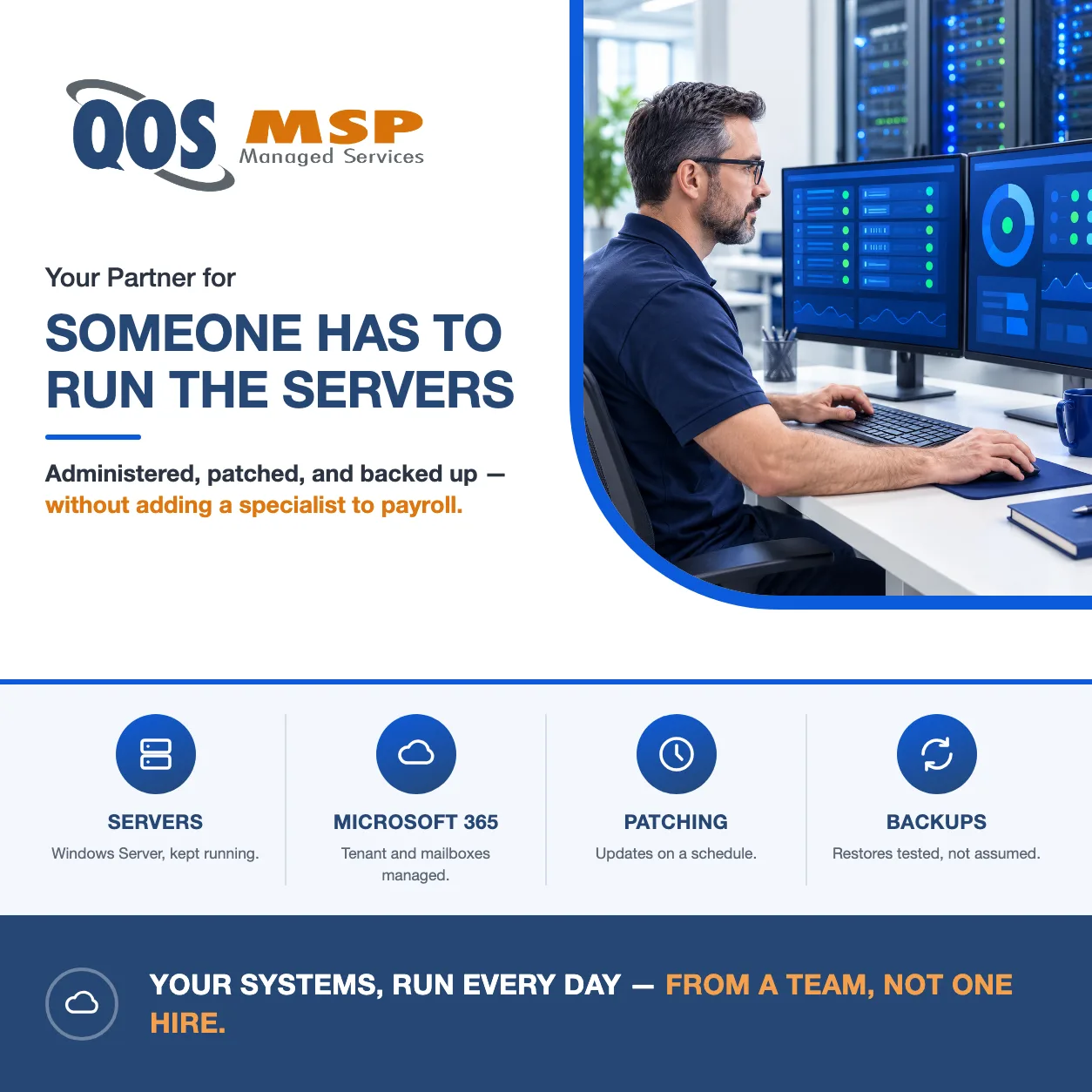
System administration is the day-to-day operation of a business's servers, operating systems, and applications — keeping them patched, monitored, backed up, and running so the people who depend on them can work. It's the role you'd otherwise hire a system administrator to fill: the person responsible for Windows Server, Microsoft 365, user accounts, and the line-of-business software your team uses every day.
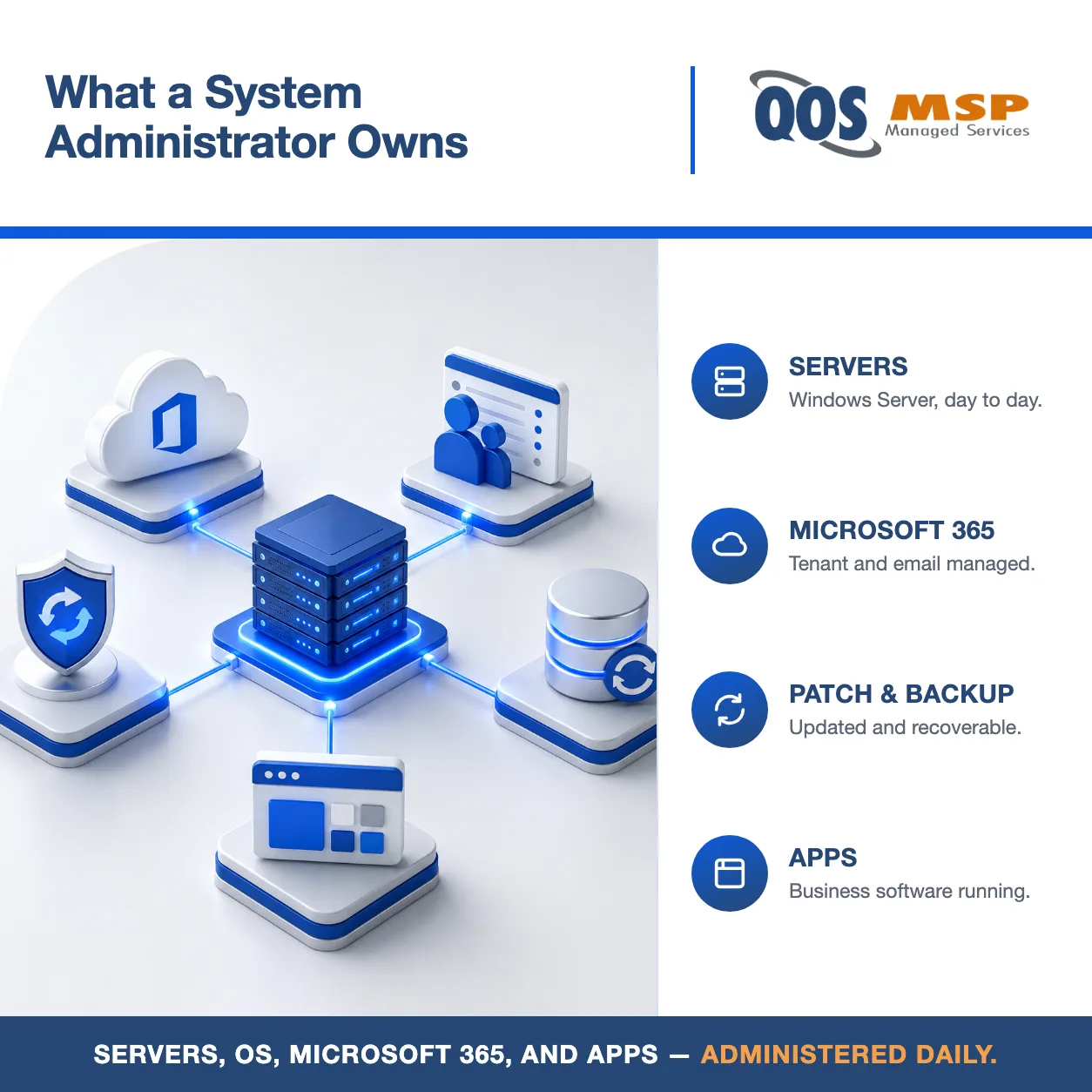
Outsourced system administration from QOS MSP includes:
- Windows Server administration and monitoring
- Microsoft 365 and Exchange Online management
- Operating-system patching and updates
- Active Directory and Entra ID user management
- Backup monitoring and restore testing
- Business application support and integration
- Server performance and capacity management
- Environment documentation and change control
One important distinction: system administration is running the servers and systems you already have. Designing and deploying new server environments is a quoted project — that’s our server infrastructure services — and monitoring your entire environment as a managed service (network, servers, cloud, and backups together) is our infrastructure management services. If the tenant itself is what you are shopping for rather than the whole admin role, that is sold on its own as managed Microsoft 365 services. This page is the role itself: the person you’d otherwise hire to administer your servers, operating systems, and applications day to day.
How QOS Covers the System Administrator Role for Indianapolis Businesses
We patch on a schedule and verify restores monthly — not just that the backup ran, but that it actually restores. A system administrator is one job; with QOS MSP it's covered by a team, so a sick day or a resignation never leaves your servers unattended. System administration covers your servers, operating systems, and applications; the network layer — switches, firewalls, VPN, and connectivity — is network administration, a separate role we also cover.
Every managed environment gets:
- A team covering the role, not a single hire
- Scheduled patching and verified backups
- Around-the-clock server monitoring and response
- System administration included in every service tier
The result is servers that get administered every day of the year — not just the days one person happens to be in the office.
How Much Does Outsourced System Administration Cost?
A fully loaded system administrator in Indianapolis runs $85,000–$125,000 a year. Here's that hire next to outsourcing the role to QOS MSP.
| Option | Annual Cost | What You Get |
|---|---|---|
| Hire an in-house system administrator | $85,000–$125,000 loaded ($70,000–$100,000 base) | One specialist, business hours |
| Outsource to QOS MSP (25-user office) | $37,500–$58,500 across tiers | System admin plus help desk, desktop, network, and security |
The pricing model is simple: the per-user fee covers the person, their primary computer, and their mobile device — starting at $125 per user per month on the Core tier ($125 / $165 / $195 across the three tiers), with each additional computer or shared workstation at $35 per month. That’s the 25-user example above: 25 users across the three tiers runs $37,500–$58,500 a year — and unlike the salary beside it, that number buys system administration plus help desk, desktop support, network administration, and security, not one role.
Two honest footnotes. The fee is management only — server hardware and software licensing are quoted separately at cost, so you’re never paying a markup buried in a bundle. And Bitdefender endpoint security is included on every managed device, not sold as an add-on. Full tier-by-tier detail is on our pricing page.
When You Actually Need an In-House System Administrator
The model fits a specific kind of business — and we'd rather tell you up front when it doesn't.
An in-house hire makes sense when you have:
- A heavy custom-application stack with daily in-house development
- A 24/7 operation needing hands physically on servers
- More than ~75 users generating full-time systems work
- Compliance requirements mandating dedicated on-staff administration
Below about 50 users, none of that is usually true: the servers still need daily administration, patching, and verified backups, but they don’t generate 40 hours a week of work — so outsourcing the role fits better than a full-time salary. And when patching crosses into active threat response — a ransomware attempt, a breached account, an exposed system — that’s our security administration team, not routine systems work.


Download the Outsourced IT Department Buyer's Guide
Deciding between a system-administrator hire and outsourcing the role is one chapter of a bigger decision. The guide breaks down every IT role — what it costs to hire, what it costs to outsource, and how to build the right mix for a growing business.
Frequently Asked Questions About Outsourced System Administration
-
What is the difference between a system administrator and a network administrator?
A system administrator runs the servers, operating systems, and applications — Windows Server, Microsoft 365, user accounts, patching, and backups. A network administrator runs the network layer — switches, firewalls, VPN, wireless, and connectivity. They're two distinct roles; QOS MSP covers both as part of one flat per-user monthly fee, so you don't hire separately for each. See network administration for that role.
-
What is the difference between system administration and infrastructure management services?
System administration is the outsourced role — a person (a team, with QOS MSP) running your servers, operating systems, and applications day to day. Infrastructure management services is a managed service that monitors your whole environment together — network, servers, cloud, and backups — as one layer. You can buy the role, the service, or both.
-
How much does it cost to outsource system administration?
Hiring a system administrator in-house in Indianapolis costs $85,000–$125,000 fully loaded ($70,000–$100,000 base). With QOS MSP the role is included in the flat $125–$195 per-user monthly fee — a 25-user office runs roughly $37,500–$58,500 a year — and that fee also covers help desk, desktop support, network administration, and security, not one role.
-
Does a small business need a full-time system administrator?
Usually not. Most businesses under 50 users don't generate 40 hours a week of systems work. The servers still need daily administration, patching, and verified backups — but that's a part-time load, which is why outsourcing the role fits better than a full-time salaried hire below that size.
-
Can QOS administer the servers and Microsoft 365 environment we already have?
Yes. QOS MSP works on a management-only model: we administer your existing Windows Server, Microsoft 365 tenant, and business applications as they are. Any new hardware or licensing is quoted separately at cost, with no markup — you're never forced to replace what already works.
-
What happens if a server fails after hours?
QOS MSP monitors servers around the clock, so a failure is detected the moment it happens rather than discovered the next morning. Standard support runs Monday–Friday, 8 a.m. to 5 p.m.; clients with a 24×7×365 support agreement get overnight response and recovery from verified backups. A single in-house administrator can't cover nights, weekends, or their own time off at all.