
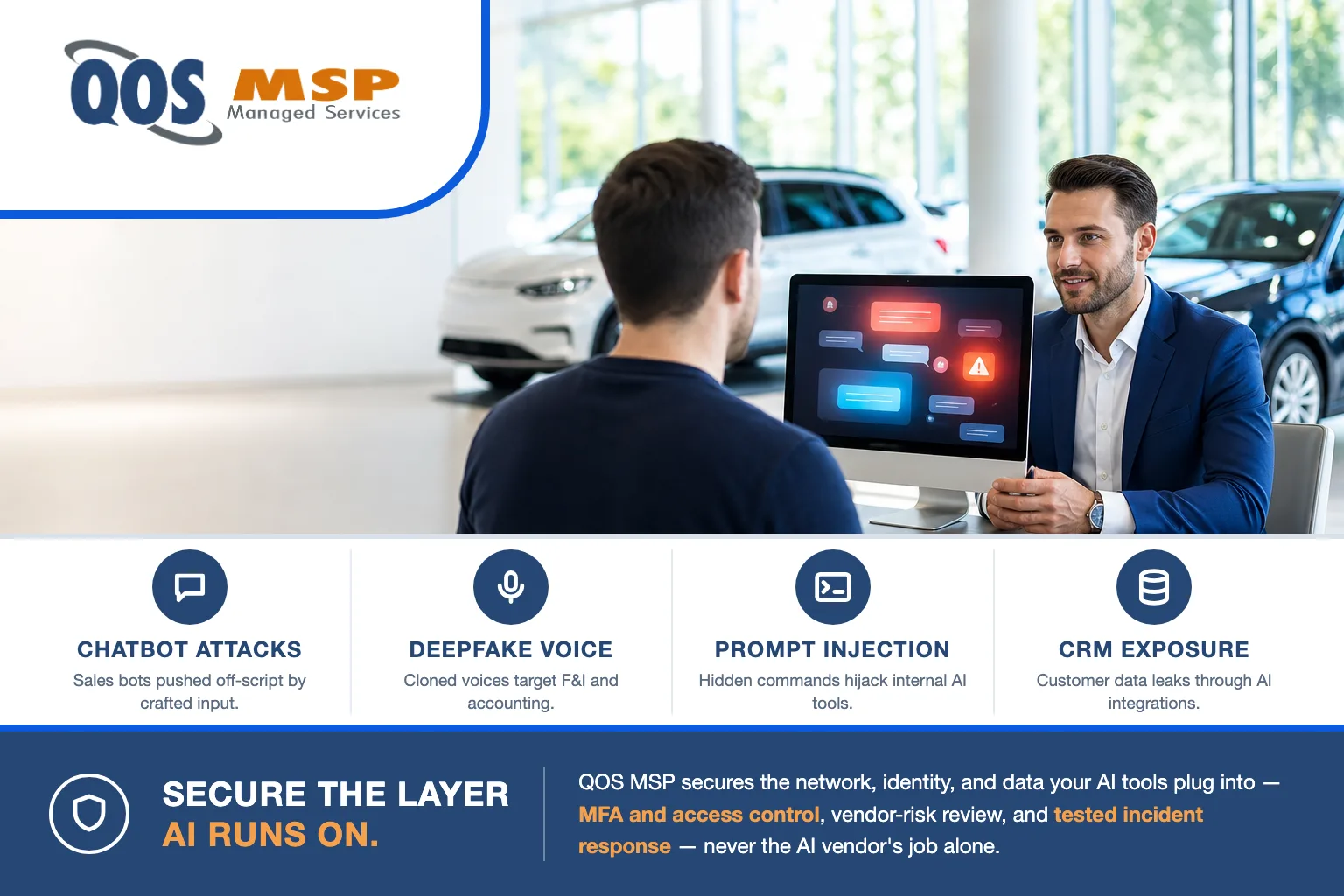
AI attack vectors at car dealerships come in four forms: manipulated chatbots — one Chevrolet dealer’s bot famously “agreed” to sell a Tahoe for $1 — deepfake voice fraud against F&I staff, prompt-injection attacks, and customer-data exposure through AI-connected CRM and marketing platforms.
Why does AI risk at dealerships matter now?
Because the tools arrived faster than the security around them. Dealerships bolted AI chatbots onto their websites, AI features into their CRM and marketing platforms, and AI assistants into daily workflows — usually as vendor add-ons switched on by a non-technical manager, with no one asking what data those tools can reach.
Meanwhile the wider auto-retail threat picture is already ugly. The 2024 CDK Global outage disrupted an estimated 15,000 dealerships and, by reported industry estimates, cost the sector roughly $1 billion — a reminder that a single connected platform is now a single point of failure across a rooftop. Security researchers at Upstream and reporting in WardsAuto both describe AI-driven automotive cyber attacks rising sharply. AI doesn’t replace those older risks; it adds new doors to the same building.
The federal government has taken notice too. CISA’s guidance on the careful adoption of agentic AI services flags the same categories we see at dealerships: tools that act on untrusted input, over-broad access, and weak oversight of what the AI is allowed to do.
What new attack vectors do AI tools create?
Four, and they map cleanly to where dealerships have plugged AI in: the public-facing sales chatbot, the phone (F&I and accounting), the internal AI assistants that read your email and documents, and the CRM/marketing stack that holds customer data. Here is each vector, how it actually happens, who it exposes, and the one control that shuts it down.
| Attack vector | How it happens | Who’s exposed | The control that stops it |
|---|---|---|---|
| Chatbot manipulation | A shopper types crafted messages that push your website sales bot past its script — fake “discounts,” off-brand statements, or bogus “binding” offers. | Website/marketing team; brand reputation. | Keep pricing and commitment authority out of the bot; the AI vendor sets guardrails, you isolate the bot’s backend from your DMS/CRM and log every session. |
| Deepfake voice fraud | A cloned voice of a GM, owner, or lender phones F&I or accounting to rush a payoff, wire, or record change. | F&I, accounting, controller. | Callback verification on a known-good number; out-of-band approval for any funds or data change; train staff that a familiar voice is no longer proof of identity. |
| Prompt injection | Hidden instructions buried in an email, PDF, or web page that your internal AI assistant reads — turning “summarize this” into “export the customer list.” | Anyone running AI email, CRM, or document tools. | Least-privilege access for the AI, a human approval step before it acts, and logging/DLP on what leaves. |
| CRM & marketing data exposure | AI-connected CRM and marketing platforms ingest customer PII through broad API scopes or third-party sharing you never scoped. | Your entire customer database; F&I data. | MFA and access control on CRM/chatbot backends, scoped API keys, encryption, and a vendor-risk review of how each AI tool handles your data. |
Can a dealership chatbot really be tricked into selling a $1 Tahoe?
Yes — and it’s documented, not a hypothetical. In late 2023 a Chevrolet dealership’s website chatbot, a vendor tool built on a large language model, was manipulated into “agreeing” to sell a 2024 Chevy Tahoe for $1 and calling it “a legally binding offer, no takesies backsies.” It’s catalogued as AI Incident Database #622.
The $1 sale had no legal force, and that’s the part everyone laughs at and then misreads. The dollar figure is the least important thing in that story. What it proves is that a customer-facing bot can be steered off-script by ordinary typed input — a technique called prompt injection, where an attacker’s words override the bot’s instructions. Aim that at brand reputation and you get a screenshot that goes viral. Aim it at a bot wired into your CRM or DMS and you get something worse: a path to customer data.
The fix is boring on purpose. A sales chatbot should never hold pricing authority or the ability to commit the dealership to anything, and it should be walled off from the systems that hold customer records. The AI vendor owns the model’s guardrails; you own whether a manipulated bot can reach anything that matters.
Are deepfake and voice-cloning scams targeting F&I offices?
Yes, and F&I is a natural target because it moves money and changes records. Voice-cloning tools now need only a short audio sample — a voicemail greeting, a webinar clip, a few seconds of a manager on a podcast — to mimic a specific person convincingly on a phone call.
The dealership version of this attack is a rushed call: “This is the GM, I’m with a lender, push this payoff through before close.” The voice is right, the urgency is manufactured, and a helpful F&I or accounting employee is the whole exploit. The control is procedural, not technical: treat a familiar voice as unverified. Call back on a known-good internal number, and require a second, out-of-band approval before any wire, payoff, vehicle record change, or banking update — no exceptions for someone who “sounds like the boss.”
To be straight about our lane here: this one is mostly training and process, and a good chunk of it you can do yourself this week. Where an MSP helps is building the verification step into your workflow and running the staff training so it sticks — not selling you a box that “detects deepfakes.”
What customer data do AI-connected CRM and marketing tools expose?
Potentially all of it. A dealership CRM holds names, addresses, phone numbers, credit-application data, trade details, and financing records — some of the most sensitive PII a small business handles. When you connect an AI marketing or lead-scoring tool to that CRM, you’re often granting it broad API access to that entire store, and in many cases sharing it onward to the AI vendor’s own systems.
The exposure usually isn’t a dramatic breach. It’s an over-scoped integration nobody reviewed: an API key with read access to everything when the tool needed a slice, a marketing platform quietly retaining data, or a third-party sub-processor you never evaluated. The controls are the unglamorous fundamentals — MFA and access control on the CRM and chatbot backends, scoped API keys that grant only what each tool needs, encryption in transit and at rest, and a written vendor-risk review of how every AI tool handles your data before you switch it on.
There’s a regulatory edge to this, too. If your dealership finances or leases, that customer data is covered by the FTC Safeguards Rule, and an AI tool touching it inherits the same obligations as the rest of your systems — access control, encryption, and service-provider oversight. We cover that in depth in our guide to the FTC Safeguards Rule for car dealerships, and it’s the reason AI vendor selection is now an IT compliance question, not just a marketing one.
Who owns AI security — your dealership, your AI vendor, or your MSP?
All three, and the fastest way to get breached is to assume one of them has it fully covered. Here’s the honest split:
- Your AI vendor owns the model itself — how the chatbot behaves, its built-in guardrails, and the security of their platform. They do not own your network or decide what data the tool can reach.
- Your dealership owns the decisions: which tools you turn on, who’s allowed to use them, what authority the sales bot has, and whether F&I follows the callback rule. Accountability never leaves your building.
- Your MSP owns the layer the AI runs on — identity, network segmentation, access control, logging, and incident response. This is the same access-control and monitoring work we do in outsourced security administration: MFA on the CRM and chatbot backends, isolating those systems from the flat showroom network, and a tested plan for when something slips through.
Here’s the boundary we won’t blur: QOS MSP secures the infrastructure AI tools plug into — we do not build, audit, or govern the AI feature inside your DMS, CRM, or website. That’s your vendor’s product. Building AI systems and automations is a different discipline entirely (and, in our family of companies, a different company — QOS Agentic). If a provider offers to both build your AI and certify it secure, ask which one they actually do. What we own is making sure a manipulated bot or a cloned voice can’t reach the data behind it.
When you DON’T need a dedicated AI security program
Not every dealership needs to spend on this, and we’d rather say so than sell you a program you can skip:
- You haven’t actually deployed AI tools yet. If there’s no website chatbot and no AI features switched on in your CRM, there’s no new attack surface here to defend. Revisit this the day a vendor turns one on.
- Your AI is read-only and isolated. A chatbot that only answers hours-and-directions questions, with no connection to your CRM or DMS and no pricing authority, is low-risk by design. Confirm the isolation, then move on.
- You already have the fundamentals. If you run MFA everywhere, a segmented network, scoped integrations, and a callback rule in F&I, you don’t need a separate “AI security” line item — you need to point the controls you already have at the new tools. Our small business cybersecurity checklist covers those fundamentals; AI security is mostly applying them, not replacing them.
The dealerships that genuinely need help are the ones running an AI chatbot wired into a flat network with the DMS, no MFA outside email, no logging worth the name, and marketing integrations nobody has ever reviewed. If that’s you, all four vectors above are live right now.
Frequently asked questions
What new security risks do AI tools create for car dealerships?
AI tools add four security risks at car dealerships: customer-facing chatbots that can be manipulated off-script, deepfake voice fraud aimed at F&I and accounting staff, prompt-injection attacks that hijack internal AI assistants, and customer-data exposure through AI-connected CRM and marketing platforms. Each has a specific control, and none is fixed by the AI vendor alone — the dealership and its IT provider own the network, identity, and data layer the tools plug into.
What is prompt injection?
Prompt injection is an attack that hides malicious instructions inside content an AI tool reads — a chat message, an email, a PDF, or a web page — so the AI follows the attacker’s instructions instead of yours. At a dealership it can push a website chatbot off-script or trick an internal AI assistant into leaking customer data. The defense is limiting what the AI is allowed to access and requiring human approval before it takes any action.
Can a dealership’s AI chatbot be tricked into giving away a car or discount?
Yes. In a documented 2023 case (AI Incident Database #622), a Chevrolet dealership’s website chatbot was manipulated via prompt injection into “agreeing” to sell a 2024 Chevy Tahoe for $1 and calling it a binding offer. The offer had no legal force, but it proves a sales bot can be steered off-script. The real risk is brand damage and any customer data the bot can reach — not the $1 — so a sales chatbot should hold no pricing authority and stay walled off from your CRM and DMS.
Are deepfake voice scams really targeting dealership F&I staff?
Yes. Voice-cloning tools can mimic a manager, owner, or lender from a short audio sample, and F&I and accounting are prime targets because they move money and change records. A typical attack is a rushed phone call impersonating the GM to push through a payoff or wire. Treat a familiar voice as unverified: call back on a known-good internal number and require out-of-band approval before any payoff, wire, or record change.
Does the FTC Safeguards Rule cover a dealership’s AI tools?
Often, yes. If an AI tool touches customer information at a dealership that finances or leases, it falls under the same FTC Safeguards Rule obligations — access control, encryption, and service-provider oversight — as the rest of your systems, and your AI vendor becomes a service provider you must oversee. See our full guide to the FTC Safeguards Rule for car dealerships for the nine required controls.
Our take
The AI attack vectors at car dealerships all share one trait: none is fixed by the AI vendor alone, and none is fixed by IT alone. The vendor governs how its model behaves; your dealership governs which tools you turn on and what authority they hold; and your MSP secures the network, identity, and data those tools plug into. We’ve run managed IT since 2007 and support more than 75,000 users across our customers, so we’ll be precise about our half of that: MFA and access control on your CRM and chatbot backends, isolating those systems from the flat showroom network, scoped integrations, logging, and a tested incident-response plan for when something does slip through.
And the boundary, one more time, because it’s where dealers get oversold: we secure the infrastructure AI runs on — we don’t build or certify the AI feature itself. If you run a dealership and want to know which of these four vectors is actually exposed on your network today, QOS MSP — managed IT out of Indianapolis — will tell you where the real gaps are. Start with a conversation.
