
About QOS MSP
QOS MSP is the outsourced IT department for Indianapolis-area businesses - managed IT, cybersecurity, cloud, and IT leadership from one accountable team. Part of QOS, delivering IT since 2007.
Contact Info
- PO Box 14, Sheridan, IN 46069
- +1 (877) 800-7672
- info@qosmsp.com
- Monday-Friday, 8:00 AM - 5:00 PM
Network Security Services in Indianapolis
Core Network Security Services We Provide
Six security layers we design and install for Indiana businesses whose firewall came from whoever set up the internet.
Firewall Design and Installation
We size, configure, and install a business firewall with a rule base built for your traffic, not defaults.
VPN and Secure Remote Access
Encrypted VPN access so hybrid staff reach business systems without exposing them to the open internet.
Intrusion Detection and Prevention
IDS/IPS deployed inline to flag and block suspicious traffic patterns before they reach your systems.
Network Segmentation
VLANs and traffic rules that isolate guest, voice, camera, and POS traffic from business-critical systems.
Network Access Control
Authentication and device policies that decide which users and devices are allowed onto the network.
Security Monitoring Setup
We stand up logging, alerting, and monitoring agents so the stack is watchable from the day it goes live.
What a Designed Security Stack Changes
Most businesses never chose their network security — it arrived with the internet circuit and nobody has looked at it since. This is the difference between a stack that was configured and one that was designed.
Without a designed stack
- ISP router doubling as the firewall
- One flat network, everything reachable
- Remote access through open ports
- No visibility into suspicious traffic
With a QOS-built stack
- Business firewall sized to your traffic
- Segmented VLANs isolating critical systems
- Encrypted VPN with controlled access
- IDS/IPS and logging in place
The Security Stack Most Small Businesses Inherited
Ask a 40-person business who chose their firewall and the answer is usually nobody. It came with the internet circuit, someone set it up on a Friday, and it has been forwarding ports ever since. Your network is also the most common entry point into your business — and in most offices it is the layer nobody has looked at since installation day.
That is what an inherited stack looks like: an ISP router doing firewall duty, one flat network where the guest Wi-Fi can reach the accounting server, remote access through ports opened years ago for someone who no longer works there, and no written record of any of it. Nothing about it is broken enough to notice — until something gets in and finds nothing in the way.
We design and install these stacks weekly, and the work always starts the same way: with your actual traffic. How many users, how many sites, what has to reach what. That produces a firewall sized to your business, VLANs that keep guest and POS traffic away from business systems, an encrypted VPN instead of open ports, and IDS/IPS watching what crosses the edge — every rule written down and every segment diagrammed.
Here is when not to buy this from us. If you know something is wrong but cannot say what, a stack build is the wrong first purchase — you would be buying hardware to solve a problem nobody has defined yet. Start with an assessment, find out what is actually exposed, then build against the findings. We would rather scope that assessment than sell you a firewall you may not need.
What Are Network Security Services?
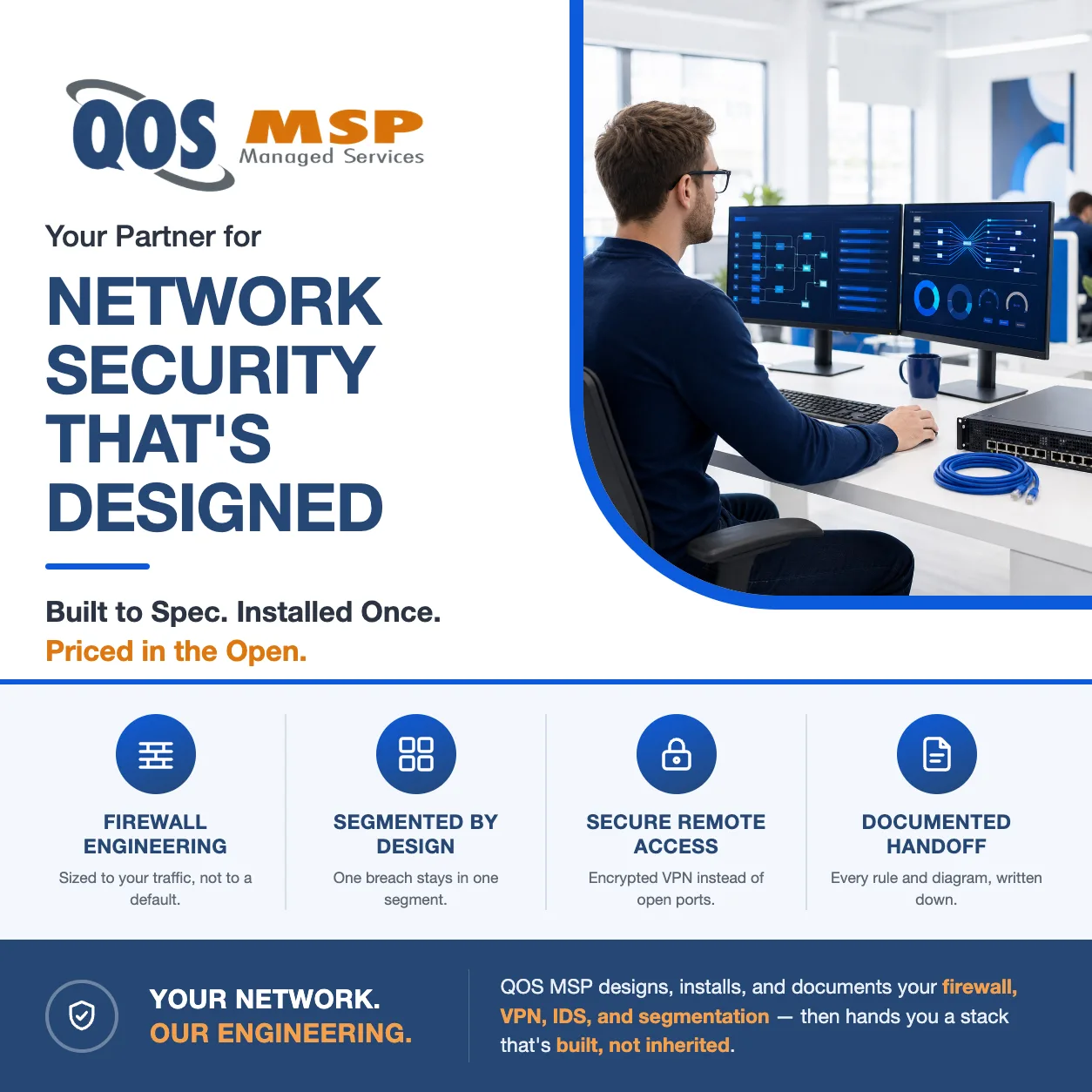
Network security services are the design and installation of the security layer that protects a business network — the firewall, VPN, intrusion detection, network segmentation, and access control that sit between your systems and everything else. QOS MSP engineers that stack as one build, installs it, and documents it at handoff.
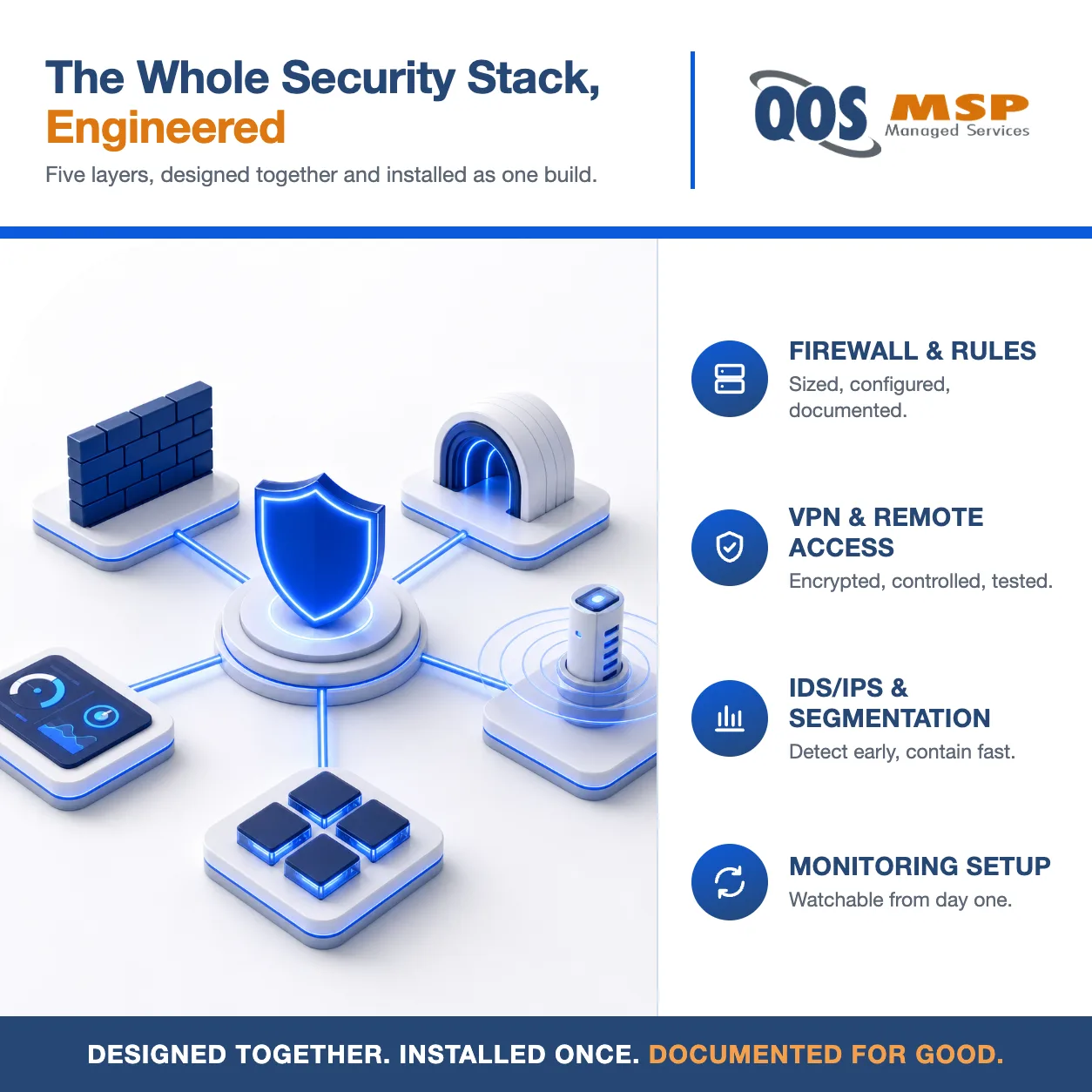
- Firewall sizing, selection, and installation
- Firewall rule base and policy design
- Site-to-site and client VPN configuration
- Intrusion detection and prevention deployment
- VLAN segmentation and traffic isolation
- Network access control and device policies
- Logging, alerting, and monitoring setup
- Security stack documentation and handoff
Why Indianapolis Businesses Choose QOS for Network Security
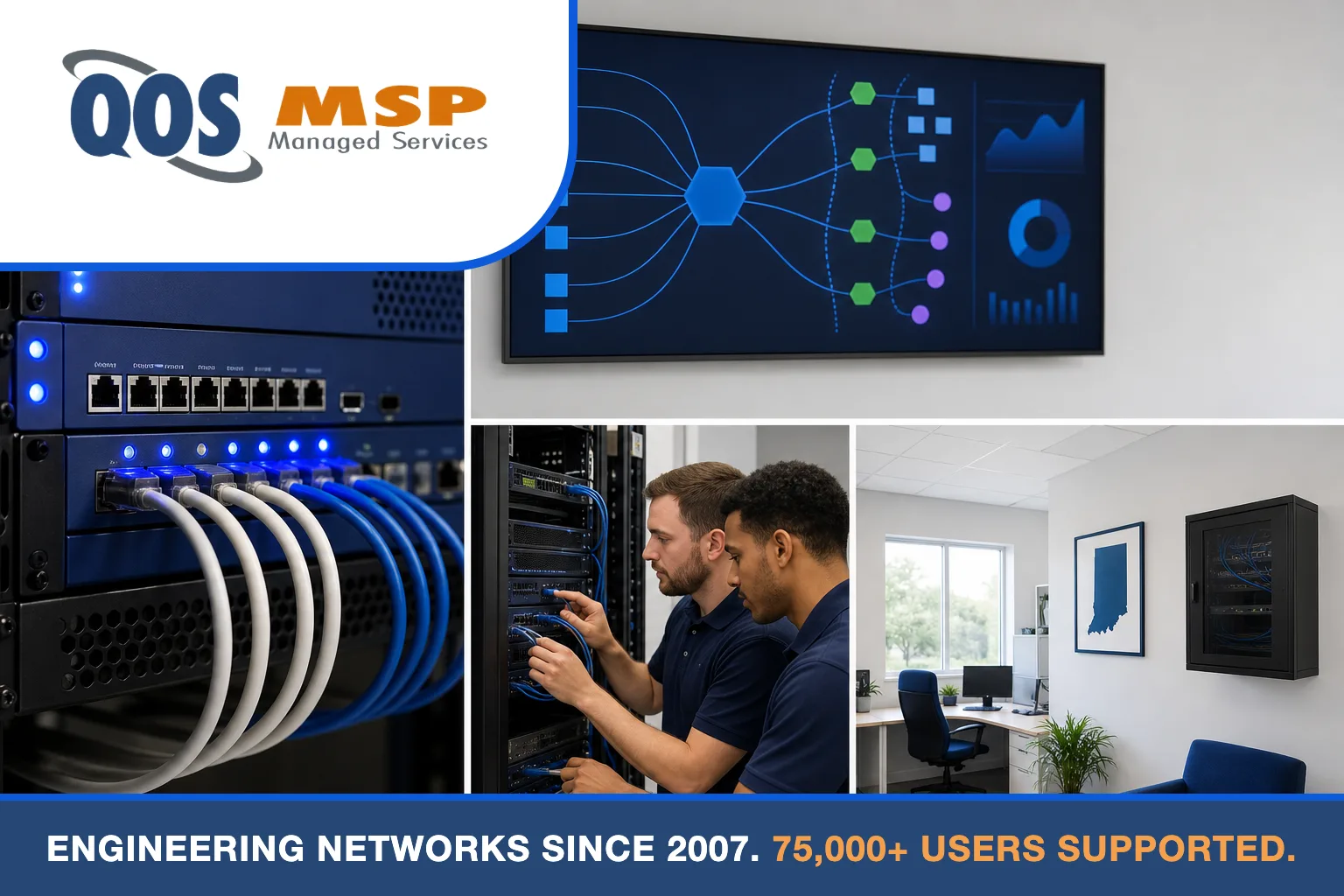
QOS has engineered business networks since 2007 — nearly two decades — and QOS MSP designs, installs, and runs them today. Our leadership carries more than 30 years of IT experience, and we have supported over 75,000 users across client environments.
- Network engineering since 2007 — nearly two decades
- 75,000+ users supported across client environments
- Vendor-neutral firewall and IDS selection
- Transparent per-device management pricing
Benefits of a Professionally Built Security Stack
A designed security stack changes two things: what an attacker can reach, and how far they get once they are in. It also makes your ongoing network cost something you can predict.

- Blocked inbound attacks at the network edge
- Contained breaches through network segmentation
- Encrypted remote access for hybrid staff
- Early detection of suspicious network traffic
- Documented firewall rules and network diagrams
- Predictable per-device management costs
Once the stack is built, security administration is the ongoing role that keeps it current — the build and the run are two different jobs, both at transparent managed IT pricing.
| What you’re buying | What it covers | Price |
|---|---|---|
| Security stack design and installation | Assessment, engineering, firewall/VPN/IDS/segmentation configuration, installation, and documentation | Quoted per engagement |
| Managed network device | Ongoing management of one firewall, switch, or access point | $25/month per device — management only |
| Hardware | Firewall, switch, and access point purchase | Billed separately |
| Vendor security subscriptions | Firewall security services, access point licensing, IDS/IPS signature feeds | Billed separately |
The $25 per-device rate covers management only. Hardware and vendor security subscriptions — firewall security services, access point licensing, IDS/IPS signature feeds — are billed separately.
Where a Security Stack Build Makes the Difference
Some networks need a firewall refresh. Others need the whole security layer rebuilt. These are the situations where the build pays for itself fastest.
- Multi-site offices needing site-to-site VPN
- Hybrid teams with remote access requirements
- Flat networks carrying guest, voice, and POS traffic
- Aging firewalls out of vendor support
If you are not sure which of these describes your network, a cyber risk assessment answers that before you spend anything on hardware — one layer of our IT infrastructure services.


Download the Network Security Stack Planning Guide
You have a quote for a firewall and no way to tell what you are actually buying. This guide breaks down the five layers of a security stack, the sizing questions to answer before anyone quotes you, and the one-time-versus-recurring cost model. You finish it able to read a security quote line by line.
Frequently Asked Questions About Network Security Services
-
What are network security services?
Network security services are the project work of designing and installing a business network's security layer: sizing and configuring a firewall, building its rule base, setting up VPN remote access, deploying intrusion detection and prevention, segmenting the network into VLANs, and standing up logging and monitoring. QOS MSP delivers all of it as one engineered build in Indianapolis, documented at handoff.
-
What's the difference between network security services and security administration?
Network security services are the project work of designing and installing the security stack: firewalls, VPNs, intrusion detection, and segmentation. Security administration is the ongoing role that runs your security day to day — threat monitoring, patching, MFA enforcement, and incident response. QOS MSP does both: we build the stack, then run it.
-
What's the difference between network security and network infrastructure services?
Network infrastructure services design and build the network itself — the switching, routing, and network design that carry every application. Network security services build the security layer on top of it: firewall, VPN, intrusion detection, segmentation, and access control. Most QOS MSP projects touch both, because VLAN segmentation is configured on the same switches the infrastructure build installs.
-
How much do network security services cost for an Indianapolis small business?
The build is quoted per engagement after an assessment, because a 15-person single office and a four-site operation need different stacks. Ongoing management of a network device — a firewall, switch, or access point — is $25 per month per device. That rate covers management only: hardware and vendor security subscriptions, including firewall security services, access point licensing, and IDS/IPS signature feeds, are billed separately.
-
What's the difference between a firewall and intrusion detection?
A firewall decides which traffic is allowed to cross your network edge, based on a rule base — this port from that source is permitted, everything else is dropped. Intrusion detection and prevention inspects the traffic the firewall allows through, matching it against known attack patterns and blocking or flagging what looks wrong. The firewall is the door; IDS/IPS watches what walks through it. Most business firewalls run both, and QOS MSP configures them together.
-
Do I need a cyber risk assessment before building a security stack?
No, not always. If you can already name what is wrong — a firewall out of vendor support, remote access through open ports, one flat network — the problem is defined and the build can be scoped straight against it. If you only know something feels wrong but cannot say what, start with a cyber risk assessment so the stack gets designed against real findings instead of guesses. Our small-business cybersecurity checklist covers what you can verify yourself before either conversation.