

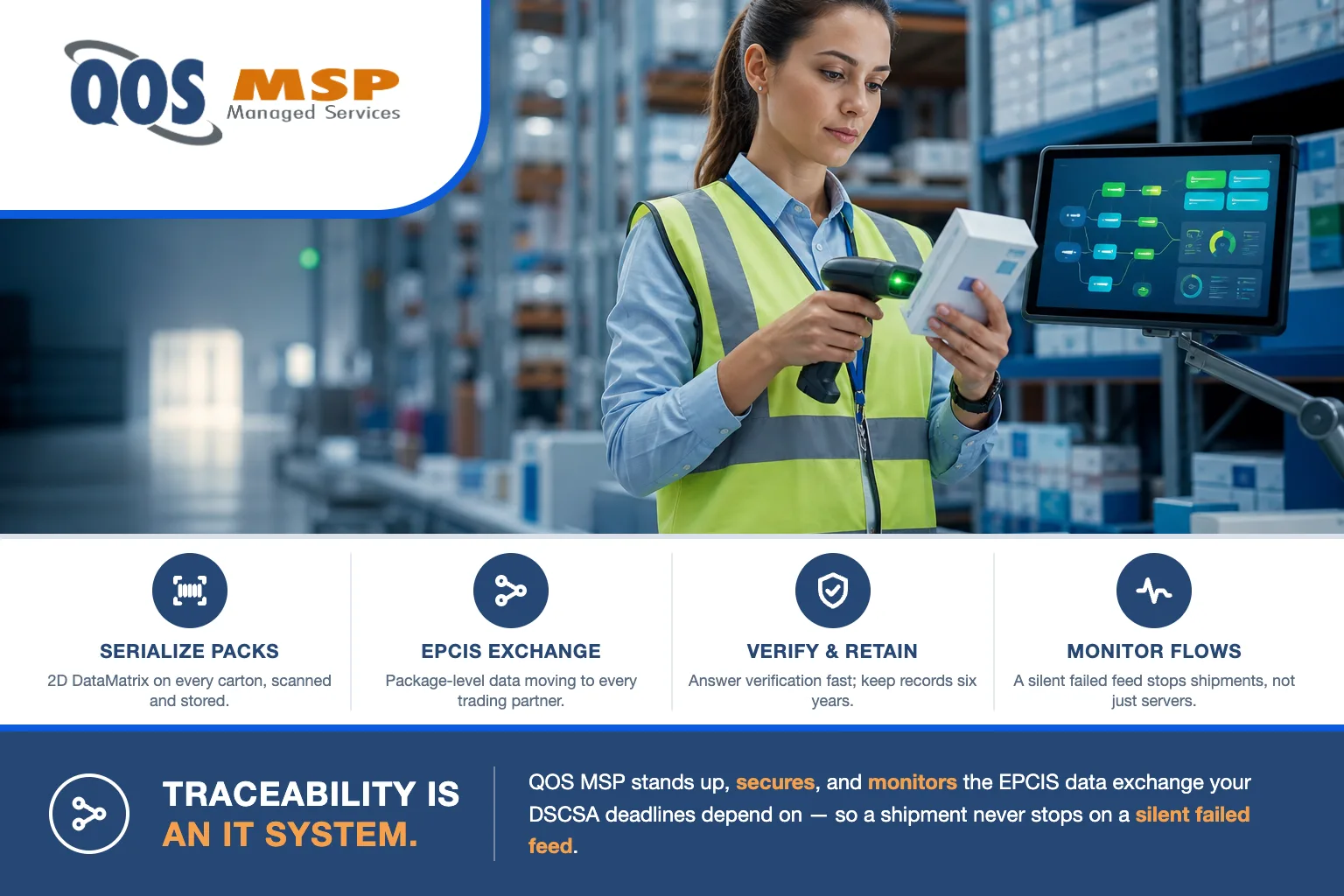
DSCSA compliance is now an IT project: since August 27, 2025, wholesalers must exchange serialized, package-level EPCIS data electronically — and trading partners refuse product that ships without it. FDA just moved small pharmacies’ deadline to November 27, 2027; everyone else’s has passed.
The Drug Supply Chain Security Act (DSCSA) reads like a regulatory problem, but the obligations it created in 2025 are almost entirely about systems: barcodes that resolve to serial numbers, data that moves between partners electronically, verification that has to answer in seconds, and records you can produce for six years. We manage the infrastructure that keeps that exchange running for regulated distributors and pharmacies, so this is the plain-English, IT-first reading of what DSCSA actually asks of you.
What just changed — and who the August 2026 extension does not help
On August 6, 2026, the FDA extended one deadline and one deadline only: the compliance date for small dispensers — pharmacies with 25 or fewer full-time licensed pharmacists and pharmacy technicians — moved from November 27, 2026 to November 27, 2027. Headcount is measured as of November 27, 2026, and the FDA has encouraged small dispensers to complete its assessment survey by September 22, 2026.
Here is the part that gets misread: this extension is not a blanket pause. It delays the requirement to send and receive full enhanced, electronic, package-level transaction data. It does not lift the rules that already applied — small dispensers must still transact only with authorized trading partners and still handle product identifiers. And it does nothing for anyone upstream. If you are a manufacturer, repackager, wholesale distributor, or a large dispenser, your DSCSA compliance deadline has already passed.
Does DSCSA apply to your operation?
DSCSA governs the trade of prescription drugs in the United States. If your business touches a prescription drug as it moves through the supply chain, you are almost certainly a “trading partner” with obligations. The main categories:
- Manufacturers and repackagers — they serialize product and originate the transaction data.
- Wholesale distributors — they pass serialized data forward and verify what they receive.
- Dispensers (pharmacies) — they receive transaction data, verify saleable returns, and respond to verification requests.
- Third-party logistics providers (3PLs) — as authorized trading partners with their own licensure and reporting duties, they move product without taking title, and the electronic data their clients require flows through their systems.
The honest 3PL answer: there is no separate FDA deadline printed for 3PLs the way there is for manufacturers or dispensers. But that is not a reprieve. Your customers are on their own DSCSA clocks, and they contractually push their serialized data exchange onto the warehouse that handles their product. In practice, a 3PL that cannot exchange EPCIS data reliably cannot keep pharma clients — the commercial deadline is whenever your biggest customer’s deadline is.
One clear exclusion: if your fulfillment operation handles only dietary supplements or OTC-only products, DSCSA does not apply — it is a prescription-drug law. The moment an Rx product enters the same building and the same systems, it does.
What does DSCSA compliance actually require? The IT reading
Strip away the legal language and every DSCSA obligation lands on a system your IT team has to stand up, integrate, secure, and keep running. Read the requirements this way and the “compliance” project becomes an integration and infrastructure project:
- Serialization and the 2D barcode — every package carries a unique product identifier in a GS1 DataMatrix barcode (GTIN, serial number, lot, expiration). Something has to scan it and something has to store it. That is a scanning workflow wired into your warehouse or pharmacy management system.
- Package-level transaction data (EPCIS) — the electronic exchange that took effect in 2025 is package-level, not lot-level. The industry standardized on GS1 EPCIS as the interoperable format. This is a data-exchange system — an EPCIS repository plus the connections (often via a network like a vendor’s exchange or direct AS2/SFTP feeds) to every partner you trade with.
- Verification — you must be able to verify a product identifier on request (for suspect product and for saleable returns) and get an answer quickly. That is an API integration with a verification router, not a phone call.
- Authorized-trading-partner (ATP) checks — you may only buy and sell with licensed, authorized partners. Maintaining and checking that status is a data and access-control problem.
- Six-year data retention — transaction information has to be retrievable for six years. That is storage, backup, and retrieval you can prove works — not a folder someone hopes is still there.
None of these is a form you file once. Each is a live system that has to talk to your partners’ systems every day. That is why we treat DSCSA compliance as belonging in the same bucket as the rest of your regulated-data obligations — see our compliance services overview for how the technical controls line up.
DSCSA deadlines and obligations by trading-partner type
The verified deadlines, and the system each one really depends on:
| Trading-partner type | Core DSCSA obligation | Enhanced electronic exchange deadline | The IT that makes it work |
|---|---|---|---|
| Manufacturers & repackagers | Serialize, originate package-level data, respond to verification | May 27, 2025 | Serialization line data, EPCIS repository, verification API |
| Wholesale distributors | Pass serialized data forward, verify receipts, handle saleable returns (stabilization period ended) | August 27, 2025 | EPCIS exchange with every partner, verification router, ATP checks |
| Large dispensers (26+ pharmacists/techs) | Receive and store package-level data, verify saleable returns | November 27, 2025 | Pharmacy system + EPCIS inbound feed, 6-year retention |
| Small dispensers (25 or fewer) | ATP-only transactions and product identifiers now; full electronic exchange later | November 27, 2027 (extended Aug 6, 2026) | Barcode capture and ATP data now; EPCIS integration ahead of the new date |
| 3PLs / fulfillment (Rx) | Authorized trading partner: licensure and reporting; move clients’ serialized data | No 3PL-specific FDA date — you exchange clients’ data on their clocks | Multi-tenant EPCIS/EDI integration, uptime, monitoring |
Why your trading partners enforce DSCSA before the FDA does
Businesses tend to plan around the FDA’s enforcement calendar. That is the wrong clock. The commercial penalty arrives first, and it is automatic.
DSCSA’s verification and saleable-returns mechanics give a receiving partner a documented basis to refuse a receipt or a return when the serialized data does not match the physical product, or simply is not there. This is a commercial practice — not an FDA mandate that a regulator has to come and enforce. If you ship a pallet whose EPCIS data never arrived or does not reconcile, the receiver can quarantine it or send it back the same day. Product sits. Invoices stall. Nobody filed a complaint; the system just worked as designed.
The same pressure shows up as questionnaires. Once you are in a regulated supply chain, your customers audit your controls before they trust their product to your systems — and they do it in writing. If you have never had to formally answer one, our guide on how to answer a security questionnaire walks through what pharma and enterprise partners will ask you to prove.
When the data exchange goes down, shipments stop
Here is the risk most DSCSA project plans underweight: once serialized exchange is mandatory, the integration layer becomes a shipping dependency. If your EPCIS feed, your EDI connection, or your verification API is down, partners cannot verify your product and product cannot lawfully or practically move. The traceability system is no longer back-office — it is tier-1, on the same footing as the systems that let you invoice or ship.
That means monitoring the flows, not just the servers. A green server does not mean EPCIS messages are actually clearing to your partners; a silent failed feed can go unnoticed until a receiver rejects a shipment. This is exactly the gap we cover under infrastructure management services — watching the transactions and integrations end to end, and why server uptime monitoring isn’t enough on its own: a box can be “up” while the business process running on it has quietly stopped.
It also means treating the exchange like the critical system it is for continuity. If the EPCIS repository or its integrations fail, you need a tested path back — a defined recovery time, restorable data, and a plan you have actually rehearsed. That is the difference between backup, disaster recovery, and true business continuity, which we break down in backup vs. disaster recovery vs. business continuity. For a DSCSA-dependent operation, “we have backups” is not the same as “we can keep shipping.”
What an IT partner owns vs. what stays with your serialization vendor and counsel
DSCSA compliance is a shared job, and being honest about the lines is what keeps a project from stalling. Here is how we divide it:
- What QOS MSP owns: deploying and securing the scanning and barcode-capture hardware and networks; standing up, integrating, administering, and monitoring the EPCIS and EDI data exchange with your partners; securing the systems that hold transaction data; building tested backup, recovery, and six-year retention; and keeping the whole exchange up and alerting when a feed fails.
- What stays with your serialization / EPCIS software vendor: the traceability platform itself — the serialization software or EPCIS solution you license. We administer and integrate that stack; we do not build it or replace the vendor’s product.
- What stays with your regulatory counsel and licensing consultant: the legal interpretation of your obligations, license status, and reporting. We are not attorneys and we are not a licensure consultant — where a question is legal, we route you to the people who own that answer.
When you don’t need us
If your serialization vendor already runs a fully managed, monitored EPCIS exchange for you and your IT team can prove restores and watch the transaction feeds, you may not need an outside partner for this at all — and we will tell you so. Bringing us in makes sense when the traceability systems live on your infrastructure, when nobody is monitoring the actual data flows, or when a failed exchange would stop shipments and you have no rehearsed way back. If that is you, talk to us and we will map the integration and continuity layer with you.
Frequently asked questions
What is the current DSCSA deadline for small pharmacies?
The deadline for small dispensers is November 27, 2027. On August 6, 2026, the FDA extended it from November 27, 2026. Small means 25 or fewer full-time licensed pharmacists and pharmacy technicians, counted as of November 27, 2026. The extension only delays full enhanced, electronic, package-level data exchange. Small dispensers must still transact only with authorized trading partners and still handle product identifiers today.
What is EPCIS and does DSCSA require it?
EPCIS is a GS1 data standard for sharing serialized, package-level product event data between trading partners. DSCSA does not name EPCIS in the law itself, but it is the de facto interoperability method the industry standardized on for the electronic exchange that took effect in 2025. In practice, exchanging DSCSA transaction data electronically means running or connecting to an EPCIS system.
Can a wholesaler refuse my product over DSCSA data?
Yes. Trading partners can refuse a receipt or a return when the serialized transaction data is missing or does not match the physical product. This is a commercial practice built into DSCSA verification and saleable-returns handling, and it happens faster than any FDA enforcement action. Product with no clean data can be quarantined or sent back the same day.
Does DSCSA apply to 3PLs and fulfillment warehouses?
Yes, when you handle prescription drugs. Third-party logistics providers are authorized trading partners with their own licensure and reporting duties. You typically do not own the serialized data, but the data your clients send flows through your systems, so you carry their electronic exchange contractually. Fulfillment limited to supplements or OTC-only products is outside DSCSA.
What happens if our traceability system goes down?
If the exchange is down, partners cannot verify product and shipments cannot move against valid data. Treat the serialization and EPCIS integration as a tier-1 system: monitor the data flows, alert on failures, and build it with tested backup and recovery so an outage is measured in minutes, not days.
