

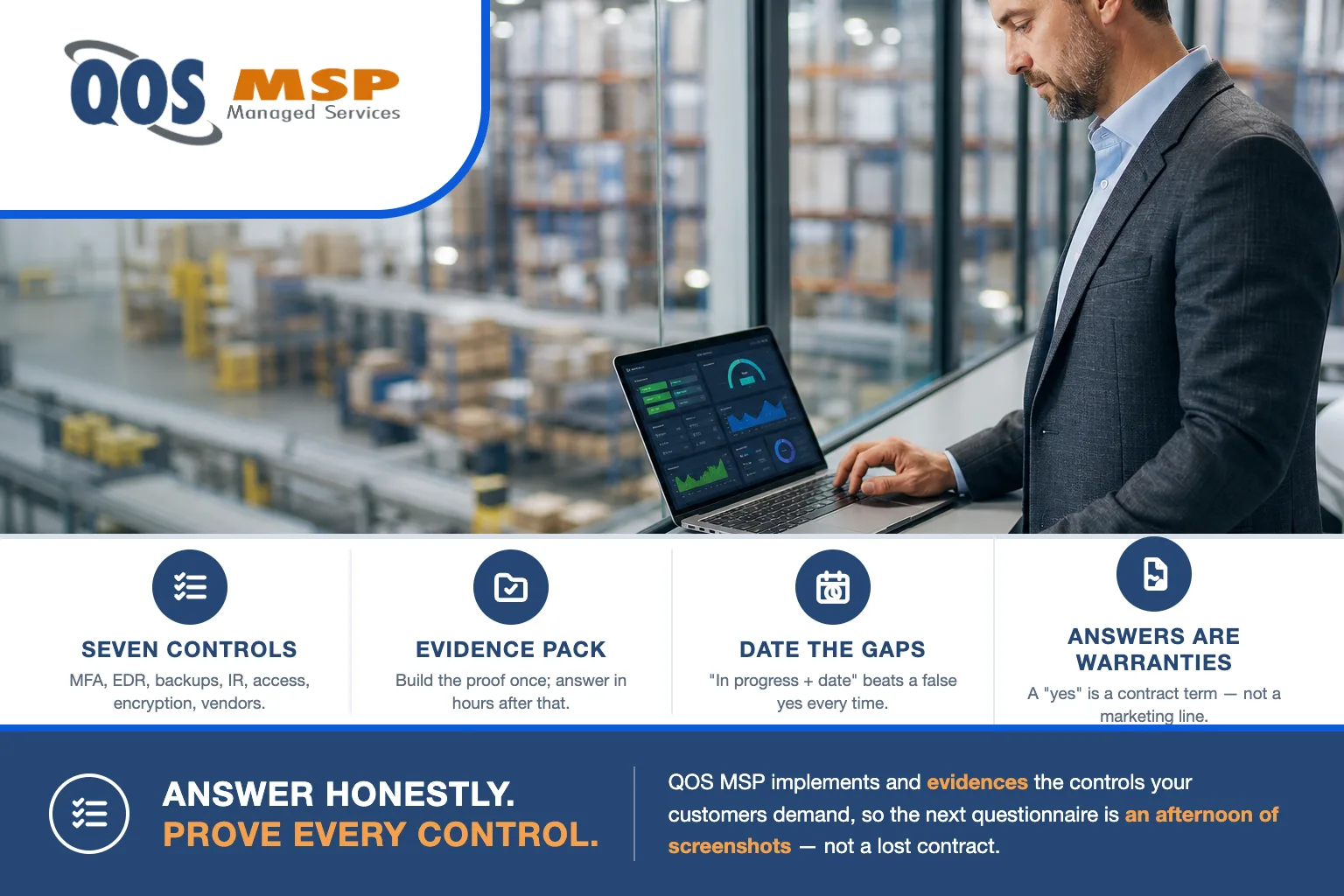
How to answer a security questionnaire is more procedure than mystery: you pass a customer security questionnaire the same way every time — answer honestly, evidence seven controls (MFA, endpoint detection/EDR, tested backups, an incident response plan, access control, encryption, and vendor management), and date every gap as an in-progress fix rather than over-attesting. The evidence, not the “yes,” is what actually satisfies the reviewer.
Why did our customer send us a security questionnaire?
Because their compliance team is now on the hook for you. A large or regulated customer that has been through a SOC 2 audit or an ISO 27001 certification is required to manage its third-party risk — and you, the vendor, are part of their attack surface. So they push their own baseline down to every partner who touches their data, orders, or systems. If you run fulfillment, warehousing, or logistics for them as a 3PL, you plug straight into their order flow, their customer records, and sometimes their network. That makes your security their problem.
Read the questionnaire for what it is: a retention event, not paperwork. It usually arrives at onboarding or renewal, and a weak or evasive response can stall a contract or lose one. The reviewer is not trying to trip you up — they are trying to document that you clear their bar so they can keep doing business with you. Treat it as a checkpoint you can pass, not a hurdle designed to fail you, and the whole exercise gets calmer.
What does a vendor security questionnaire actually ask?
The wording varies by customer, but the questions collapse to the same seven controls almost every time. What trips vendors up is the gap between how a question is phrased and what it is really testing — and the fact that a “yes” is only worth the document you can attach to it. Here is the matrix we walk clients through: the question as asked, what it means, and the evidence to attach.
| Question as asked | What it really means | Evidence to attach |
|---|---|---|
| Do you require multi-factor authentication? | Is MFA enforced — not merely available — on email, VPN, remote access, and every admin account? | MFA policy exports/screenshots from M365 or Google, the VPN, and RDP/remote access showing enforcement, including admin accounts. |
| Do you use endpoint protection? | Do you run EDR/MDR (behavioral detection and response), not just signature antivirus, on every device? | An EDR/MDR console report listing each endpoint, agent health, coverage percentage, and who monitors the alerts. |
| Do you back up your data? | Are backups offsite/immutable and restore-tested — proven recoverable, not just “running”? | Backup job logs plus a dated restore-test record showing a test recovery actually succeeded. |
| Do you have an incident response plan? | Is there a written, dated IR plan with named roles and a notification clock you would actually follow? | The IR plan document with roles, a contact tree, breach-notification timelines, and evidence it was reviewed or tabletop-tested. |
| How do you control access? | Least-privilege and joiner/mover/leaver — who can reach what, and how fast access is revoked when someone leaves. | An access-review export and your offboarding checklist showing admin rights are limited and promptly removed. |
| Is data encrypted? | Encryption at rest and in transit for laptops, servers, and anything holding their data. | Disk-encryption (BitLocker/FileVault) status reports and confirmation that connections use TLS. |
| How do you manage your own vendors? | Vendor management — you are being asked to do to your subcontractors exactly what this customer is doing to you. | Your vendor inventory with risk tiers and evidence you review key subprocessors’ security. |
If that list looks familiar, it should: cyber insurance carriers ask for the same seven controls — same evidence, different sender. We break the insurer version down in cyber insurance requirements for small business. Build the evidence once and it answers both.
What is an evidence pack — and why build it once?
An evidence pack is a single, reusable folder of proof — the screenshots, exports, and policy documents that back every “yes” on the questionnaire. Build it once and each future questionnaire stops being a scramble: the first one takes days, and every one after it takes hours, because the artifacts already exist and you are only refreshing dates. Here is how we assemble it.
- Map your controls to the seven questions. For each control, write one plain sentence stating exactly how it is configured today — that sentence becomes your answer.
- Export the proof for each. MFA enforcement screenshots, the EDR console report, backup logs with a dated restore test, the written IR plan, an access review, encryption status reports, and your vendor inventory.
- Date and label every artifact. An underwriter or reviewer trusts a report stamped last month far more than an undated one; freshness is itself evidence.
- Note the gaps honestly. Wherever proof does not exist yet, write the remediation and a target date — that becomes your in-progress answer instead of a false “yes.”
- Store it in one place and assign an owner. A shared, access-controlled folder someone keeps current, so the next questionnaire is a copy-paste, not a project.
One caution while you gather the monitoring evidence: reviewers increasingly want proof you would see an attack, not just that a server is up. If your only monitoring pings a box for a heartbeat, read why server uptime monitoring isn’t enough before you attach it — a green uptime dashboard is not security monitoring.
How to answer a security questionnaire honestly when the answer is “no”
You will hit questions where the honest answer is no. Answering “yes” anyway is the one move that can actually hurt you later (next section). The pattern that keeps you credible is “in progress + date”: state what is not yet in place, the specific step you are taking, and when it will be done. “MFA is enforced on email and VPN today; RDP and admin accounts are scheduled for enforcement by March 31” reads as a competent partner managing risk — far better than a bare “no,” and far safer than a false “yes.”
The other honest move is the scoped “no, because…”. If a question does not apply — you do not store the customer’s cardholder data, say, so a PCI control is out of scope — say so plainly and explain why. Reviewers respect a precise no. What they distrust is a vague yes that collapses under one follow-up question. When the gaps are real and you want a plan to close them, our small business cybersecurity checklist walks the same controls in plain English so you can knock them out before the next round.
What happens if you over-attest?
A “yes” on a customer security questionnaire is not a marketing claim — it is a contractual representation. Your answers are frequently referenced by, or attached to, the master services agreement, which means you are warranting them as true. Check “yes, MFA is enforced everywhere” when it only covers email, and you have not saved yourself an awkward conversation — you have created a misrepresentation that surfaces at the worst possible moment.
That moment is a breach. If an incident traces back to a control you attested to but did not actually have, you are exposed on two fronts at once: the security failure itself, and a documented false statement your customer relied on. Contracts get terminated and indemnification clauses get invoked over exactly this. The honest “in progress + date” answer carries none of that risk — a dated, truthful gap is respected; a convenient false “yes” is a liability with your signature on it. Over-attesting never buys what it promises.
Frequently asked questions
Do we need SOC 2 to pass a customer security questionnaire?
No. Most small providers pass with documented controls and current evidence, not a formal report. SOC 2 is an audit performed by a licensed CPA firm, and many customers accept a completed questionnaire backed by proof instead. Pursue SOC 2 only when a specific contract requires the report itself.
How long does it take to answer a security questionnaire?
The first one typically takes one to two weeks, because you are assembling the evidence for the first time. With a maintained evidence pack, later questionnaires take a few hours — you are refreshing dates and copying proof you already have, not rebuilding it.
Can we just answer yes to everything and fix it later?
No. Your answers are contractual representations, so a false yes that a customer relies on becomes a misrepresentation if a breach exposes it. A dated in-progress answer that states what you are fixing and by when is respected and carries no such risk.
Is a customer security questionnaire the same as a cyber insurance questionnaire?
They test the same seven controls — MFA, EDR, tested backups, an incident response plan, access control, encryption, and vendor management — so one evidence pack answers both. The sender and the stakes differ: a customer can end a contract, while an insurer can deny a claim or void a policy.
What if our 3PL has no internal IT staff at all?
That is common, and it is not a blocker. A managed IT provider runs and evidences the controls for you — enforcing MFA, deploying EDR, testing backups, and producing the reports. You still own the answers and sign them, but you are not assembling the proof alone.
How an MSP shortcuts the questionnaire
Here is the boundary, stated plainly, because getting it wrong wastes your money. QOS MSP is not an auditor, a law firm, or a certification body. We do not issue a SOC 2 report — that comes from a licensed CPA firm — and we do not certify ISO 27001 — that comes from an accredited certification body. We also do not interpret your contracts; that is your attorney’s lane.
What QOS MSP does is implement, run, and evidence the technical controls the questionnaire asks about: enforcing MFA everywhere, deploying and monitoring EDR, protecting and restore-testing backups, tightening access control, confirming encryption, and helping you write and test the incident response plan. Then we produce the reports that let you answer truthfully and prove each control — the daily work of security administration. We have run managed IT since 2007 and support more than 75,000 users across our customers, so the controls your customers ask about are the ones we deploy every week. If you want the gaps mapped before you fill anything in, that is exactly what a cyber risk assessment produces.
So the division is clean: you own the answers; we own the controls behind them. Learning how to answer a security questionnaire is mostly learning to keep the evidence current — and that is the part we can carry for you. Have a questionnaire on your desk and no security team behind you? We will map your controls, close the real gaps, and hand you the evidence pack. Get in touch.
